Paul Gugelmann and his “poetic machines”
Few people have heard of Paul Gugelmann and his “poetic machines,” yet these creations stay in the memory of those who see them for a long time and make them search for his other works.
Paul Gugelmann and the birth of the “poetic machines”
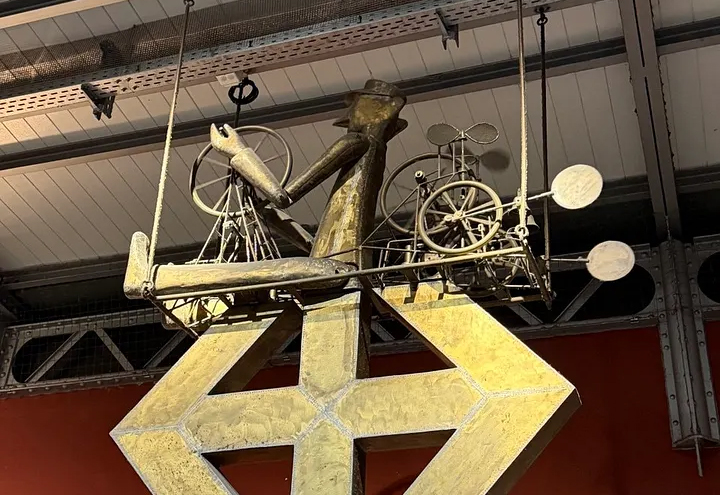
Paul Gugelmann (1929–2017) was a Swiss artist specializing in moving (kinetic) sculptures who turned mechanisms into poetry.
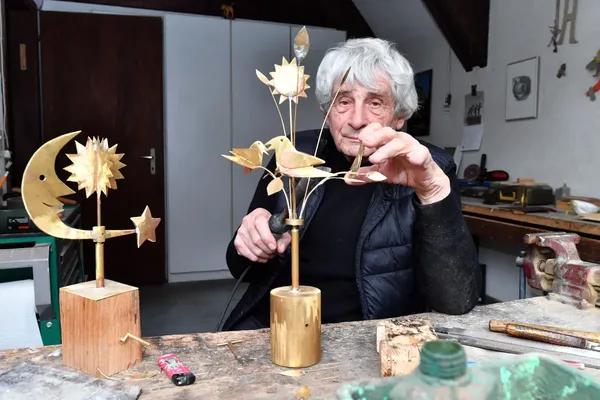
He did not study at an art academy. He worked as a shoe designer at Bally and even lived in Paris.
It was there, far from home, that he began to build his first strange devices — initially out of curiosity, using toy steam engines.
Over time, his mechanical toys became more complex: gears, levers, and figures of people and animals. Everything began to move and “tell a story.” Paul Gugelmann called them “poetische Maschinen” — poetic machines.
These were not just mechanisms, but small scenes in which something happens, sometimes slightly absurd and slightly ironic. Gugelmann’s works gained popularity, and some private companies and institutions commissioned various mechanisms from him.
His works can be found across the country — in cities, on bridges, near post offices, and in public squares.
He had a distinctive style. His works combine technology, humor, and philosophy; they offer a light satire of everyday life and create the feeling that the machines are “alive.” Paul Gugelmann created clear, almost fairy-tale-like scenes. Movement and sound, metal and simple mechanisms, along with a playful approach to technology, made his works unique.
Gugelmann is a rare example of an artist who came to art from an ordinary profession, made technology emotional and humorous, and turned complex mechanisms into simple human stories. His works are like small theatrical performances made of metal.
The Paul Gugelmann Museum in Schönenwerd
Paul-Gugelmann-Museum — a small art museum in the municipality of Schönenwerd, canton of Solothurn, Switzerland. It is dedicated to “poetic machines” and is located in a historic house in the center of Schönenwerd.
Many of the works are powered by steam or mechanical drives and are accompanied by light, sound, and humorous narratives.
Gugelmann deliberately refused to sell his machines; instead, he transferred them to a dedicated foundation. Based on this collection, the current museum was created, comprising around forty unique objects.
The museum occupies several floors of an old house, where the works are displayed in intimate rooms with wooden structures, emphasizing the handcrafted nature of the machines. Visitors can only view the exhibition with a guide: volunteer guides operate the mechanisms, explain how they work, and tell the stories behind each object.
For groups of up to about 45 people, private tours are available by prior reservation via phone or email. In June and July, an annual temporary exhibition of a guest artist is usually held, during which some of Gugelmann’s works are temporarily removed, but the main “poetic machines” remain accessible.
The museum houses more than 40 of his “poetic machines.” Almost all of them move and are demonstrated live to visitors. It is a small, intimate museum, but very lively, where visitors experience not just an exhibition but a full performance involving these mechanical sculptures. It is essentially the “home” of his art.
Admission to the Paul Gugelmann Museum is quite affordable:
Current prices:
• Adults: 10 CHF
• Children under 16: free
• With the Swiss Museum Pass: free
Visits are only possible with a guide (this is part of the museum’s concept; the guided tour is included in the ticket and lasts approximately 1–1.5 hours).
The museum is open on Wednesday, Saturday, and Sunday from 14:00 to 17:00. In summer (approximately July–August), the museum is closed. At other times, group visits can be arranged by appointment.
Official website: https://www.gugelmann-museum.ch
Museum address: Schmiedengasse 37, 5012 Schönenwerd, Switzerland
“Poetic machines” across Switzerland
Gugelmann also created public sculptures on commission, and they are scattered across Switzerland.
For those who enjoy visiting different places and creating their own quests to find objects, this is a great opportunity to explore Switzerland and many of its most beautiful places and cities.
Paul Gugelmann’s works can be seen in the following locations:
• Olten (Bahnhof) — the “Bähnler”
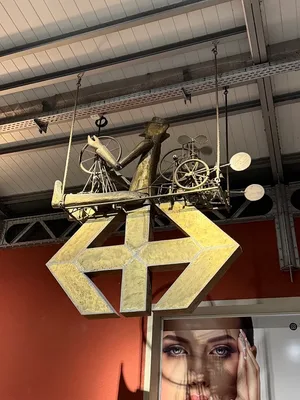
• Aarau (main post office) — the work “Ikarus” (moves on request)
• Schönenwerd (his hometown): “Yorick” (in a nursing home), “Aquacipedalus” (in a swimming pool), “Nepomuk” (on a bridge)
• Gretzenbach — “Meridian” near a school
There are not many of them, because Gugelmann created them individually as unique pieces and sold almost none; many works remained in the foundation and are now exhibited in the museum. Some works are also located on private or restricted premises and are not accessible to regular visitors.
The railway worker at Olten station
Many people passing through Olten railway station do not notice one of Paul Gugelmann’s remarkable works. However, all locals know it, as it comes to life every hour and attracts attention with its unusual sound.
This is the kinetic sculpture “Bähnler” (railway worker).
The sculpture comes alive every hour (usually exactly on the hour). At that moment, it begins to move and produces a characteristic “ding-dang” sound, similar to a railway crossing signal. So it is not in constant motion, but rather a short “performance” once an hour.
The sculpture is dedicated to railway workers and others who work on the railways. Switzerland has one of the best railway networks and an excellent infrastructure. Train punctuality reaches around 90–95%, with a perfectly coordinated transfer system and nationwide coverage. It is a special culture, and Olten is a key transport hub, making the theme especially fitting.
The character itself is a slightly ironic “driver/worker” who turns a mechanism, as if operating a train or a handcar. The mechanism produces a sound reminiscent of old railway crossing signals. Gugelmann combined humor, technology, and everyday life into a single piece.
The sculpture has become part of the “character” and atmosphere of Olten station — many passengers hear it every day, and for locals it is almost a “sound symbol” of the station.
A short video of the railway worker sculpture at Olten station in Switzerland to draw attention to the remarkable works of Paul Gugelmann:

Hunt for Paul Gugelmann’s Poetic Machines:
Find at least 3 different “poetic machines” and try to understand what they “tell” (their meaning or idea), and also come up with your own name for each of them. Guess how they work inside.
Only after that, read about these poetic machines and compare your thoughts and ideas with those of the author.
Events

Country: Switzerland
- Morges Tulip Festival — Switzerland's Free Answer to KeukenhofApril - May
- Medieval Spectacle Hinwil — Switzerland's Biggest Knight TournamentMay
- Caves Ouvertes Vaudoises — The Swiss Wine Weekend That Lets You Into Local LifeMay
- Swiss National Day — The Complete Guide to August 1st (2026 Edition)August 1
- The Day Rolle Winds Back a Century: The Barrel Organ Festival on Lake GenevaAugust
- Tractors, Confetti and New Wine: Harvest Festivals in SwitzerlandSeptember - October
- When the Bells Come Down the Mountain: Switzerland’s Living Alpabzug TraditionSeptember - October
- The light show “Rendez-vous Bundesplatz” in Bern: it’s worth seeingOctober
Tags

Jojo is Joyful Journeys!