Jet d'Eau Geneva — The Fountain That Was Never Meant to Be Famous
The Jet d’Eau is not a fountain in the traditional sense. There are no sculptures, no basins, no decorative flourishes. It is simply water — shot 140 meters into the sky from the surface of Lake Geneva at 200 km/h. And somehow, it has become the most recognizable symbol of an entire city.
Up close, it is easy to understand why. Walking along the jetty, with the spray drifting through the air, the Jet d’Eau feels less delicate than powerful. A clean, vertical line of white water rising against the Alps, the lake, and the sky. No ornament needed.
But what makes it truly interesting is not only how it looks — it is how it all began.
It Was an Accident
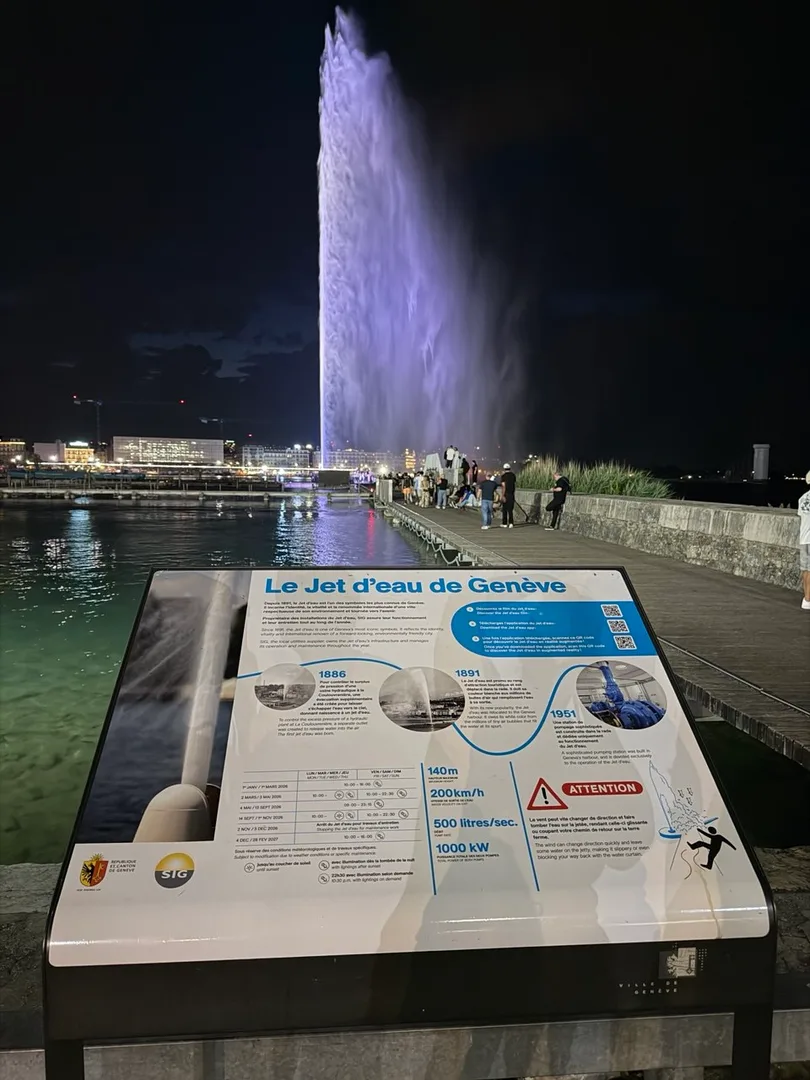
The Jet d'Eau was never designed to be a landmark. The original version appeared in 1886 near the Coulouvrenière hydraulic plant. Its job was entirely practical: it served as a pressure relief valve for the city's hydraulic system. When excess pressure built up, the valve released water upward. That first jet reached about 30 meters.
But people noticed it. The tall column of water looked impressive against the lake. In 1891, the city moved the fountain closer to the lake — to a more visible position — so it could become part of Geneva's public image. The modern version was installed in 1951, drawing water directly from the lake and operating as a standalone attraction.
From a safety valve to a national symbol. That's a very Swiss story: take something practical, refine it, and let it speak for itself.
The Numbers
The Jet d'Eau pumps roughly 500 liters of water per second. The water leaves the nozzle at approximately 200 km/h and reaches a height of about 140 meters — roughly the height of a 45-story building.
At any given moment, around 7,000 liters of water are suspended in the air above the lake. The jet appears snow-white not because the water is treated, but because millions of tiny air bubbles mix with the water and reflect sunlight — creating that distinctive bright white column.
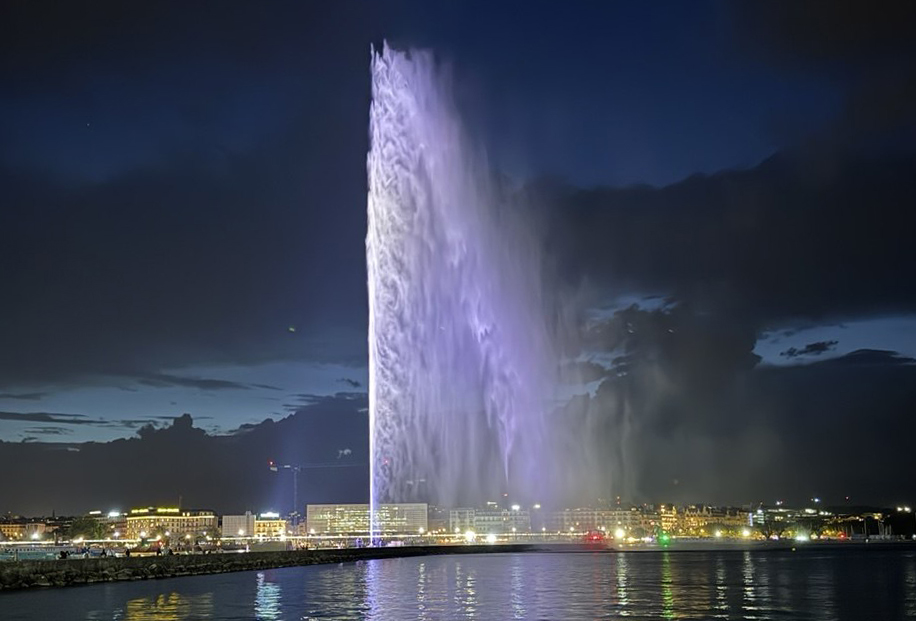
At night, the fountain is illuminated — usually white, but on special occasions it's lit in different colors for holidays, international events, or public awareness campaigns.
Why Geneva Is So Proud of It
Every city has its symbol. Paris has the Eiffel Tower. Sydney has the Opera House. Geneva has a column of water.
What makes it unusual is that there's no myth behind it, no royal decree, no architect's grand vision. It grew from infrastructure into icon organically. And there's something very Genevan about that: precise, powerful, clean in form, connected to water, not overloaded with decoration, not pompous — but impossible to forget.
For Geneva — international, calm, meticulous, quietly confident — the Jet d'Eau is the perfect symbol. It says everything without trying to say anything at all.

BEST VIEWPOINTS
The fountain sits where Lake Geneva narrows into the Rhône, so it's visible from almost everywhere in the city center. But some angles are better than others.
Jetée des Eaux-Vives (the jetty) — walk out along the breakwater to get as close as possible. You'll feel the spray on your face. On windy days, the mist shifts direction and you can get completely soaked — which is either a warning or a selling point, depending on your sense of adventure.
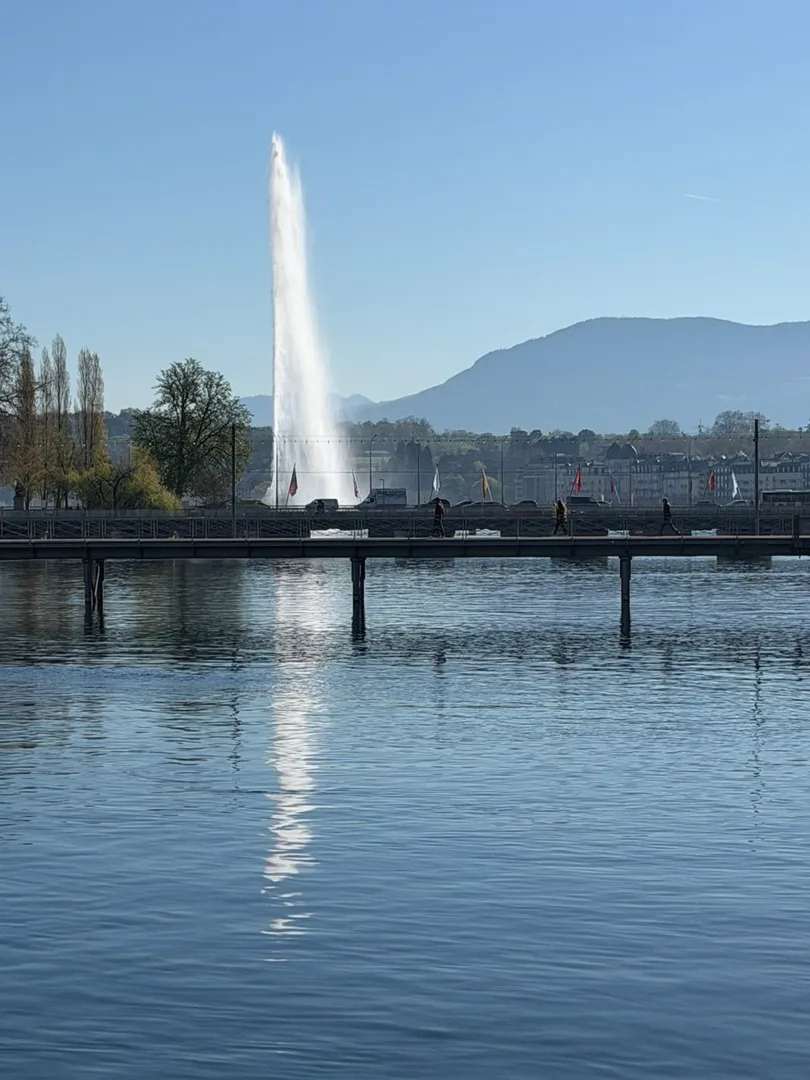
Pont du Mont-Blanc — the bridge gives you the classic postcard shot: the fountain framed by the lake, with the old town and mountains behind it.
Jardin Anglais — the English Garden on the south bank. A good spot for photos with the fountain and the city in one frame.
From the air — if you're flying into Geneva, look out the window. The Jet d'Eau is visible from the plane, and it's one of the few landmarks in the world that you can spot during approach.
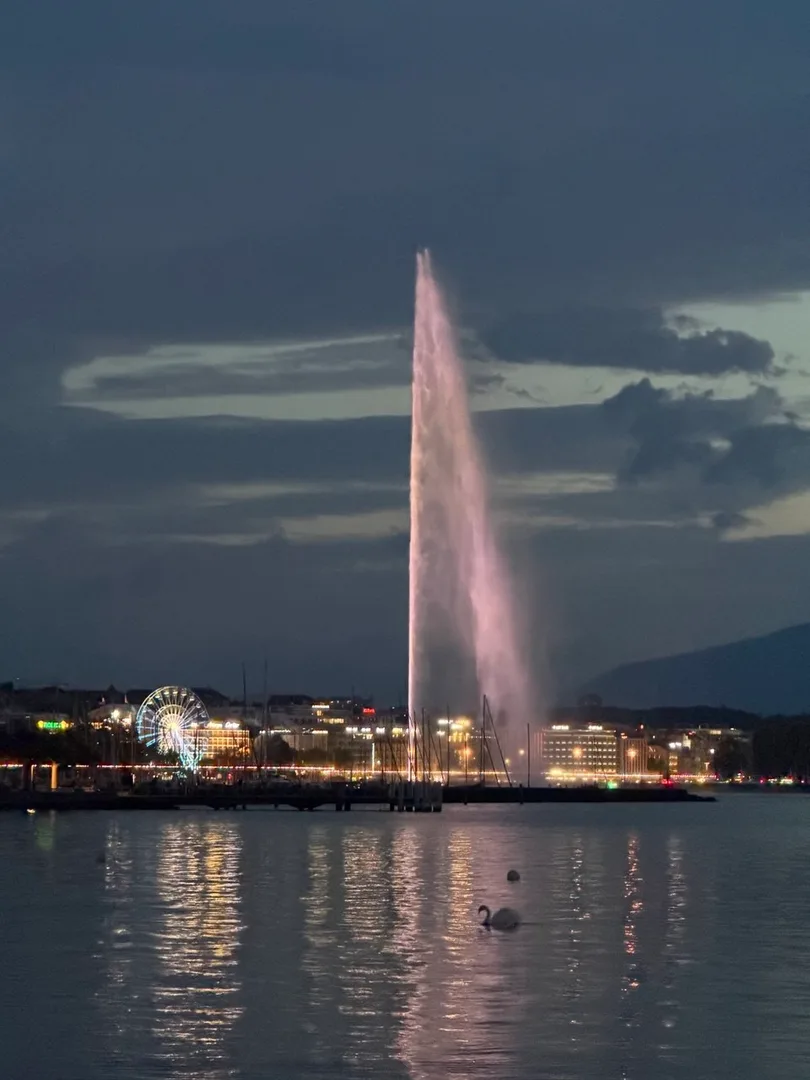
At sunset and at night — in the evening, the fountain against the illuminated city, the dark lake, and sometimes the moon creates some of the most striking photos. In sunlight, especially in the afternoon, a rainbow often appears in the spray when light passes through the water mist.
Practical Information
Detail | Info |
|---|---|
Name | Jet d'Eau de Genève |
Location | Quai Gustave-Ador, 1207 Genève (center of Geneva Bay) |
Coordinates | 46.2074, 6.1559 |
Height | ~140 meters |
Water speed | ~200 km/h |
Flow rate | ~500 liters/second |
Entry | Free — visible from anywhere, walkable from the jetty |
Operated by | SIG (Services Industriels de Genève) |
Official info |
Operating Hours 2026
Period | Hours |
|---|---|
Jan 1 – Mar 1 | 10:00–16:00 (illuminated until 22:30 on request) |
Mar 2 – May 3 | Mon–Thu: 10:00–sunset (illuminated until 22:30 on request); Fri–Sun: 10:00–22:30 illuminated |
May 4 – Sep 13 | 09:00–23:15, illuminated |
Sep 14 – Nov 1 | Mon–Thu: 10:00–sunset (illuminated until 22:30 on request); Fri–Sun: 10:00–22:30 illuminated |
Nov 2 – Dec 3 | Closed for maintenance |
Dec 4 – Dec 31 | 10:00–16:00 (illuminated until 22:30 on request) |
The fountain may be turned off due to strong wind, low temperatures, or other weather conditions. Check the forecast and current schedule before visiting.

Don't just look at it from one spot. Walk the full loop: start from Jardin Anglais, cross Pont du Mont-Blanc for the classic angle, then walk along the Eaux-Vives side to the jetty. From each point, the fountain looks completely different — different backdrop, different light, different relationship with the lake and the city.
If it's sunny, go in the afternoon — that's when the rainbow appears in the spray. If you want photos with the city lights, come after dark on a Friday or Saturday when the fountain runs with full illumination until 22:30.
And leave time for a simple moment. Sit on the lakeside, watch the fountain, and do nothing for ten minutes. Sometimes the best memory of Geneva isn't a museum or a watch shop — it's the lake, the fresh air, the white jet against the sky, and a few quiet minutes with no agenda.

Events

Country: Switzerland
- Morges Tulip Festival — Switzerland's Free Answer to KeukenhofApril - May
- Medieval Spectacle Hinwil — Switzerland's Biggest Knight TournamentMay
- Caves Ouvertes Vaudoises — The Swiss Wine Weekend That Lets You Into Local LifeMay
- Swiss National Day — The Complete Guide to August 1st (2026 Edition)August 1
- The Day Rolle Winds Back a Century: The Barrel Organ Festival on Lake GenevaAugust
- Tractors, Confetti and New Wine: Harvest Festivals in SwitzerlandSeptember - October
- When the Bells Come Down the Mountain: Switzerland’s Living Alpabzug TraditionSeptember - October
- The light show “Rendez-vous Bundesplatz” in Bern: it’s worth seeingOctober
Tags

Jojo is Joyful Journeys!