Geneva's Flower Clock — The Ad Without a Sign and the Clock Nobody Uses to Tell Time
Have you ever stood in front of the Flower Clock in Geneva and taken a photo? Of course you have — everyone does. But did you know you were photographing an advertisement? One with no brand name, no logo, no slogan — just 12,000 flowers arranged in a circle that happens to show the exact time, synchronized by satellite.
The Flower Clock is probably the most photographed clock in the world that almost nobody actually uses to check the time. And that quiet irony is the most Geneva thing about it.
What It Actually Is
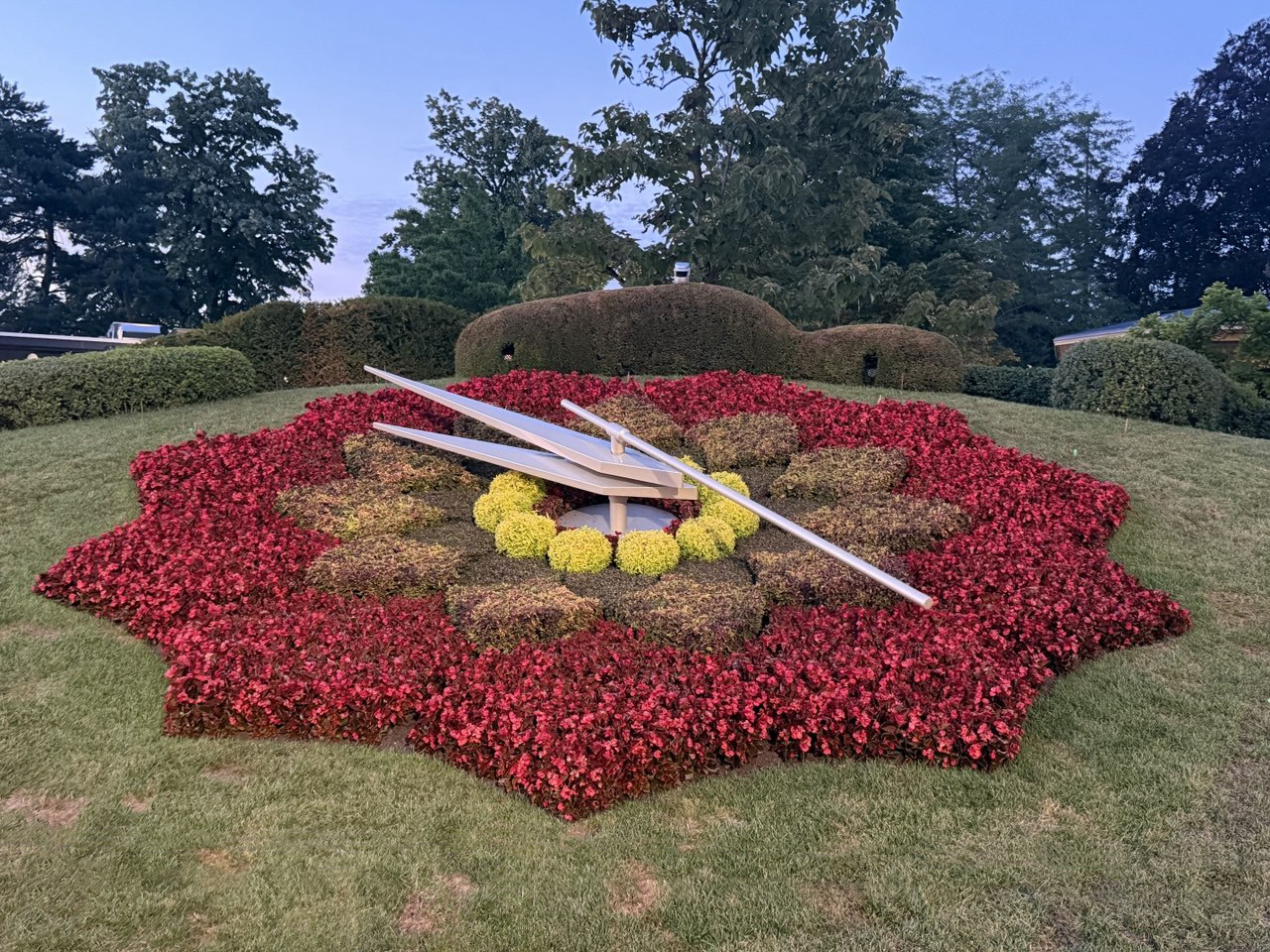
L'Horloge fleurie — the Flower Clock — sits in the Jardin Anglais (English Garden), on the shore of Lake Geneva, near the Quai du Général-Guisan. It's not a decorative flowerbed shaped like a clock. It's a real, working timepiece with a mechanical movement, a second hand roughly 2.5 meters long, and a dial about 5 meters across — all made of living plants.
The clock was created in 1955 as a tribute to Geneva's watchmaking industry. Not a tribute to any specific brand — a tribute to the idea itself. Geneva = precision. No billboard needed. Just flowers, gears, and the kind of understated confidence that defines this city.
It's a perfect combination of Geneva's two great crafts: watchmaking and landscape gardening. A clock planted in the earth. Swiss precision rooted in soil, rain, and seasons.
The Facts That Make It Interesting
It's advertising without a sign
The Flower Clock was conceived as a symbol of Geneva's watchmaking tradition. It doesn't promote a brand. It doesn't sell anything. It simply says, without saying it: this is a city that takes time seriously. The softest, most elegant product placement in history — and it's been working since 1955.
It was once the largest flower clock in the world
With its 5-meter dial and 2.5-meter second hand, Geneva's clock held the world record for decades. In 2005, Tehran built one with a 15-meter dial. An almost symbolic moment: the city with the world's greatest watchmaking reputation lost the size record — but not the recognition. Nobody flies to Tehran to photograph a flower clock.

The best time to take photos is spring and summer, when the design is at its brightest, but in winter, the clock also retains its shape thanks to decorative plants and seasonal composition.
The numbers keep changing
How many plants are in the clock? It depends on who you ask. Tourist guides often say 6,500. Geneva's official tourism office says about 12,000 flowers and plants. Both can be correct — the number changes with each seasonal replanting, and it depends on whether you count only the blooming flowers or the entire planting. The design is refreshed four times a year, each time with a different pattern and color palette. Some locals call it a "défilé de mode végétal" — a botanical fashion show.
It's synchronized by satellite
Here's the beautiful contradiction: the outside is flowers, soil, rain, and the unpredictability of nature. The inside is a precision mechanism synchronized to satellite time. A clock that lives in the rhythm of seasons but displays accuracy to the second. The most Swiss paradox imaginable.
It's the "front door" to watchmaking Geneva
Many tour guides start or end their watchmaking tours at the Flower Clock. Start here — the easy, visual, photogenic symbol — and then walk to the boutiques and workshops on Rue du Rhône, the Patek Philippe Museum, the old town, and the deeper layers of Geneva's horological world. The clock is the introduction; the city is the story.
It reveals how Geneva sees itself
Most cities put up statues of generals or kings. Geneva put flowers and a clock. That tells you everything about this city's self-image: precision, craft, order, horticulture, and quiet elegance. No monuments to power — a monument to accuracy.
The History
The Flower Clock was created in 1955 by Geneva's Parks and Promenades Service, on the initiative of the Association des intérêts de Genève — an organization promoting the city's identity. The lead designer was landscape architect Armand Auberson, who had also created the rose garden at Parc de la Grange ten years earlier.
The idea was distinctly Genevan: combine the city's two strengths — watchmaking and meticulous urban gardening — into a single object. The result was not a monument to a person or an event, but a visual symbol of what Geneva stands for.
The timing mattered too. This was the postwar era, when European cities were actively reinventing their public spaces and creating new recognizable landmarks. The Flower Clock became Geneva's "soft advertisement" — it doesn't shout about the city's status, but it immediately reads as Switzerland: precision, order, craft, cleanliness, care.
The clock was redesigned in 2002 by artist Josée Pitteloud and sculptor Jean Stern. So what you see today isn't the frozen 1955 original — it's a living landmark that the city periodically updates and maintains.
A small historical footnote
Geneva's Flower Clock wasn't actually the first in Switzerland. According to historical records, the first Swiss flower clock was built in 1900 at the Grand Hôtel des Avants above Montreux. But Geneva's version became the famous one — because it was placed in exactly the right spot: the center of the tourist route, by the lake, next to the promenade, steps from the old town. Location, as always, is everything.

Stand in front of the Flower Clock. Check the time it shows. Now check your own watch or phone.
Are they the same? They should be — the clock is satellite-synchronized. If yours is off, congratulations: a flowerbed in Geneva just proved it's more precise than your device.
Practical Information
Detail | Info |
|---|---|
Name | L'Horloge fleurie (The Flower Clock) |
Location | Jardin Anglais, Quai du Général-Guisan, Geneva |
Entry | Free, always accessible |
Dial diameter | ~5 meters |
Second hand | ~2.5 meters (one of the longest among flower clocks) |
Plants | ~12,000 (replanted 4 times per year) |
Created | 1955, redesigned 2002 |
Best for photos | Spring and summer (brightest patterns), but the clock maintains its form year-round with seasonal plants |

As locals say: "If you've been to Geneva and didn't photograph the Flower Clock — were you really in Geneva?"
For many visitors, this is the confirmation shot — the proof you were here. Like the Eiffel Tower in Paris, the Manneken Pis in Brussels, or the Astronomical Clock in Prague. In Geneva, that role belongs to the Jet d'Eau and the Flower Clock.
So take the photo. But also take a moment to appreciate what you're looking at: a city that chose to represent itself not with a monument to a king or a general, but with a clock made of flowers. That says more about Geneva than any statue ever could.
And combine it with the Jet d'Eau — they're a 5-minute walk from each other. The fountain shows Geneva's energy. The clock shows its precision. Together, they tell the full story.

Events
Country: Switzerland
- Morges Tulip Festival — Switzerland's Free Answer to KeukenhofApril - May
- Medieval Spectacle Hinwil — Switzerland's Biggest Knight TournamentMay
- Caves Ouvertes Vaudoises — The Swiss Wine Weekend That Lets You Into Local LifeMay
- Swiss National Day — The Complete Guide to August 1st (2026 Edition)August 1
- The Day Rolle Winds Back a Century: The Barrel Organ Festival on Lake GenevaAugust
- Tractors, Confetti and New Wine: Harvest Festivals in SwitzerlandSeptember - October
- When the Bells Come Down the Mountain: Switzerland’s Living Alpabzug TraditionSeptember - October
- The light show “Rendez-vous Bundesplatz” in Bern: it’s worth seeingOctober
Also available in
Tags

Jojo is Joyful Journeys!