CERN Science Gateway — Where the Universe Gets Explained for Free (25 Min From Geneva)
CERN may look like another museum stop, but it is not a museum. CERN is the place where modern physics is actually happening — right now, underneath your feet, in a 27-kilometer ring of superconducting magnets 100 meters below the ground. And somehow, you can walk in for free, spend three hours learning how the universe works, and take the tram back to Geneva in time for dinner.
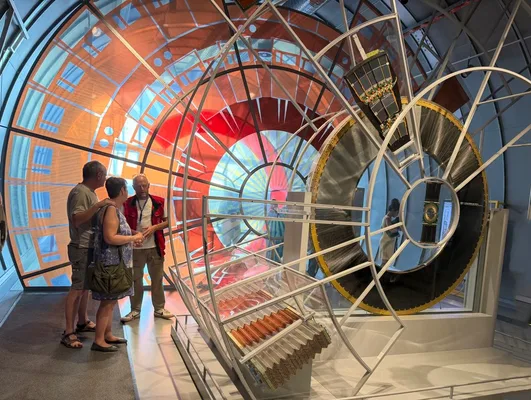
CERN isn't a historical site or a monument. It's a working laboratory where thousands of scientists are actively trying to answer the biggest questions in physics: what is matter made of, what happened in the first moments after the Big Bang, and why the universe exists at all. The fact that they've built a visitor center where any person — with no science background — can understand what they're doing and why it matters is what makes this visit extraordinary.
What Is CERN
CERN — the European Organization for Nuclear Research — is one of the world's largest particle physics laboratories. It sits on the border between Switzerland and France, just outside Geneva. Founded in 1954, it now hosts around 17,000 scientists, engineers, and staff from over 110 countries.
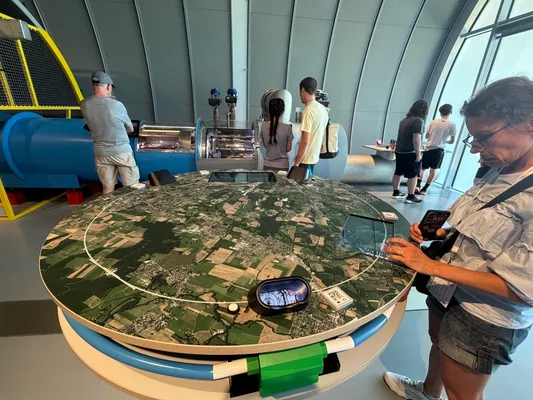
The most famous instrument here is the Large Hadron Collider (LHC) — a 27-kilometer circular tunnel roughly 100 meters underground. Inside it, beams of protons are accelerated to 99.9999991% of the speed of light and smashed together inside massive detectors. The collisions recreate conditions that existed a fraction of a second after the Big Bang, allowing scientists to study the fundamental building blocks of matter.
CERN is famous for two things that changed the world:
The Higgs boson. In 2012, the ATLAS and CMS experiments at CERN confirmed the existence of the Higgs boson — the particle that explains why other particles have mass. It was one of the most important scientific discoveries of the 21st century and led to a Nobel Prize in Physics.
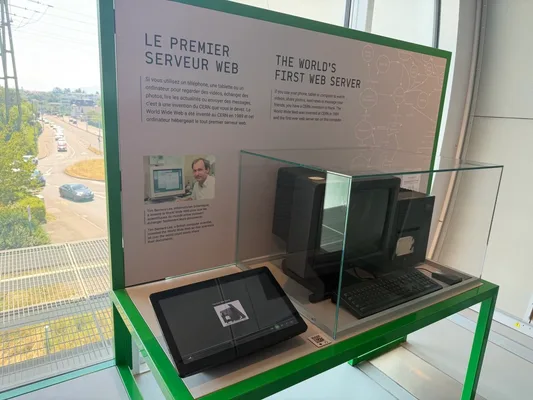
The World Wide Web. In 1989, a CERN scientist named Tim Berners-Lee invented the World Wide Web as a way to share data between researchers. Every website you've ever visited exists because of an idea born in this building. CERN made the technology available for free — and the rest is history.
Science Gateway — The Visitor Center
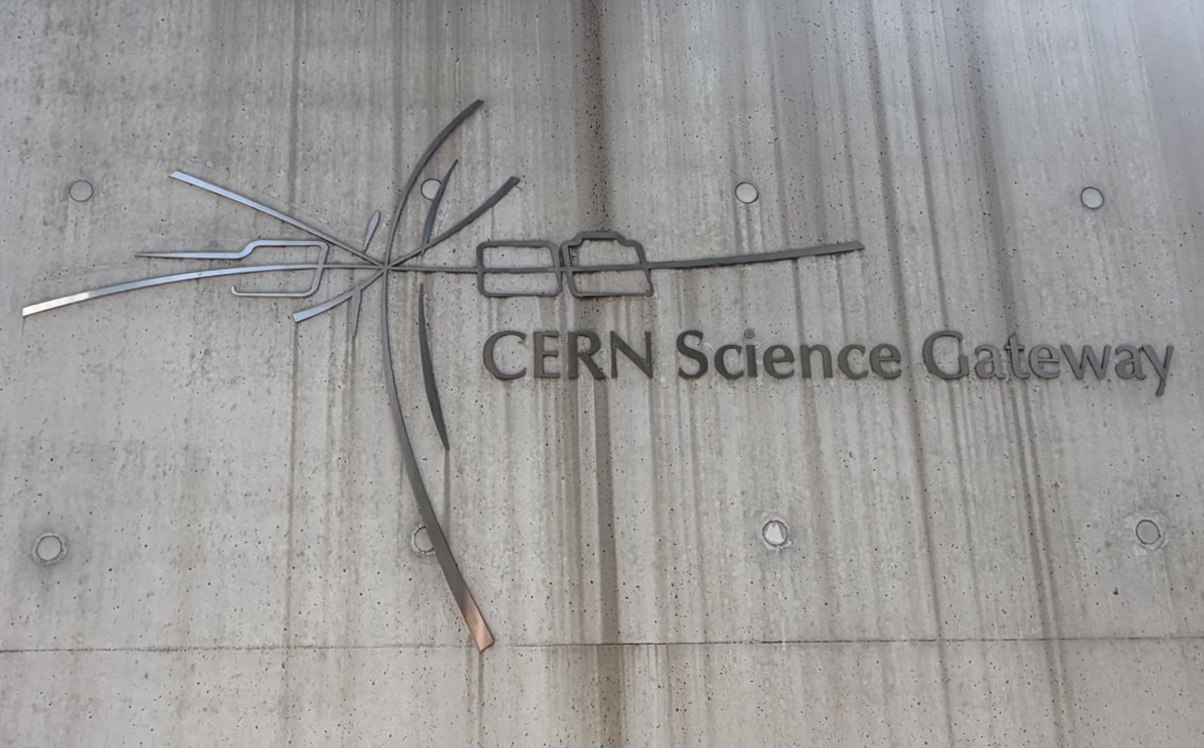
The main destination for visitors is the CERN Science Gateway, opened in October 2023. The building itself is worth seeing: it was designed by Pritzker Prize-winning architect Renzo Piano, spans 7,000 m² across five sections, and features two elevated tubes that mirror the LHC tunnel 100 meters below. 400 trees were planted around it, and solar panels on the roof make the building carbon neutral.
Entry is free. Registration is required.
The three main exhibitions
Discover CERN — how particle accelerators work, what detectors do, and how scientists "see" particles that are invisible to the human eye. This is where you understand the machine.
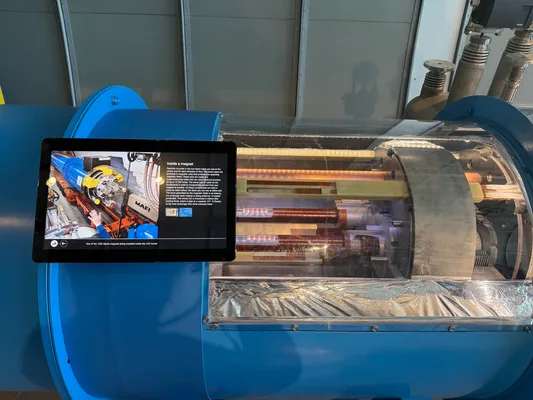
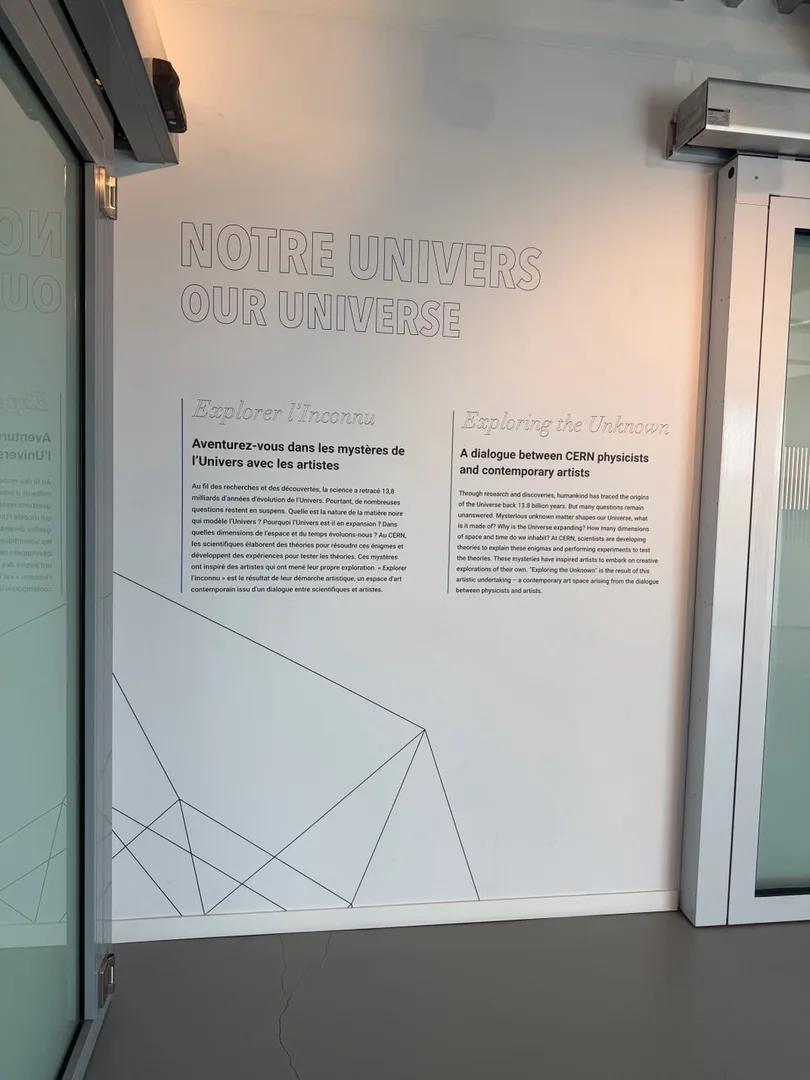
Our Universe — the story of 13.8 billion years, from the Big Bang to today. How matter formed, how stars ignited, how the elements that make up your body were forged inside dying stars.
Quantum World — the strangeness of the subatomic realm. Superposition, entanglement, uncertainty. The part of physics where intuition stops working and reality gets weird.
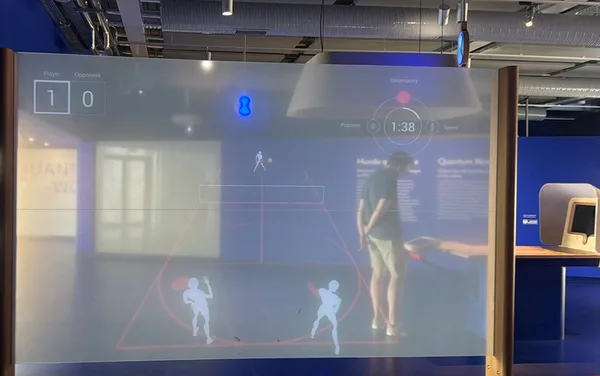
The exhibitions are designed for self-guided visits, but CERN guides are present on the floor and happy to answer questions. Interactive elements throughout make the science accessible without dumbing it down — it works for adults, teenagers, and curious kids alike.
Globe of Science and Innovation
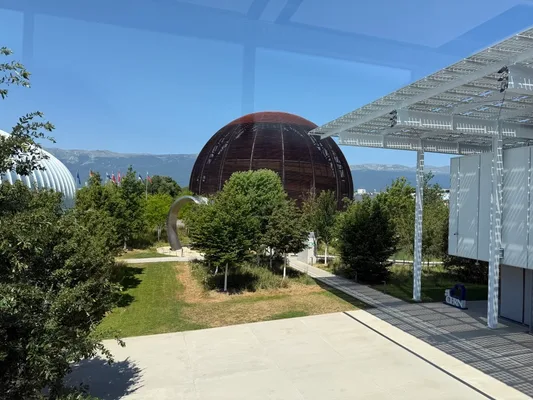
Across from Science Gateway stands the Globe — a large wooden spherical structure that has become one of CERN's visual symbols. Originally built for the Swiss National Exhibition in 2002, it was later gifted to CERN to mark the organization's 50th anniversary. Worth a photo stop.
Big Bang Café and Shop
The café serves food with a view of the Globe. The shop has science-themed gifts, books, and CERN-branded souvenirs — from mugs to particle physics posters. Both are inside Science Gateway.
Getting a Guided Tour — The Honest Truth
This is the part most websites don't tell you clearly. Here's how it actually works:
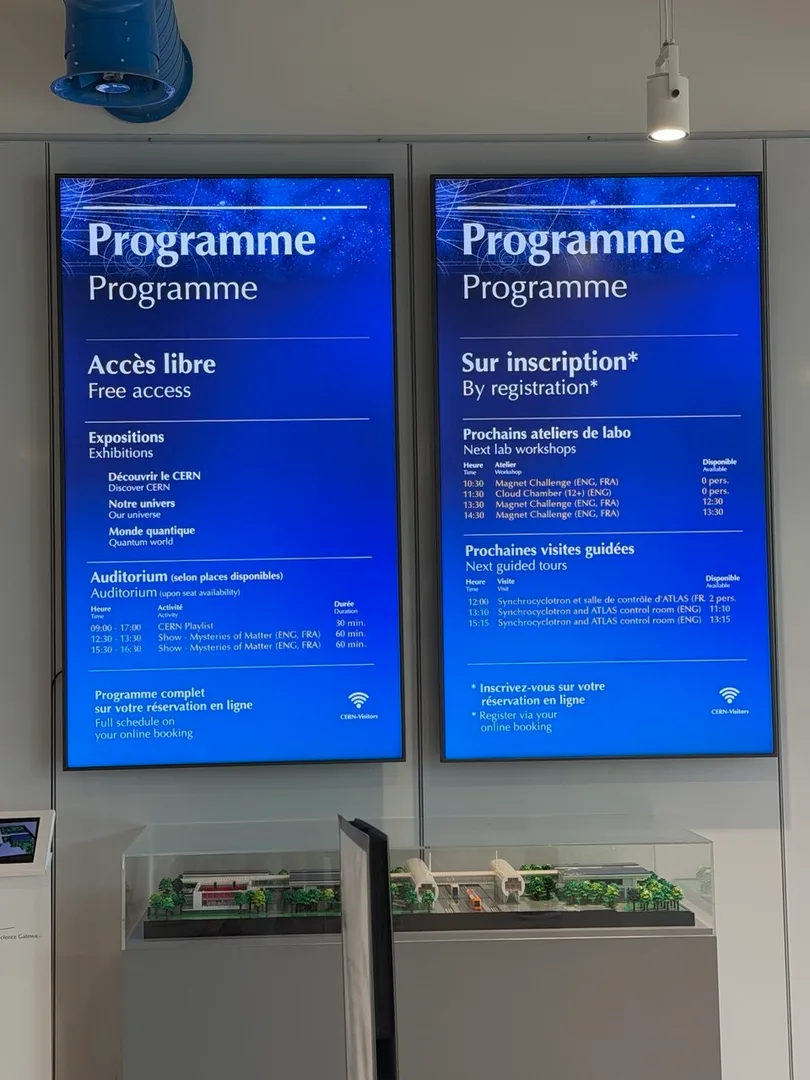
Guided tours and lab workshops cannot be booked in advance by individual visitors. You register for them after arriving, through a web app or at the reception desk. Places are distributed first come, first served.
Only about 10% of visitors get a spot. CERN says this directly. Demand is extremely high, capacity is limited.
Tours last about 90 minutes, are usually in English (sometimes French), and are recommended for ages 14+. They may include areas like the Synchrocyclotron (CERN's first accelerator, now decommissioned and open for visits), or control rooms — but not the LHC tunnel itself.
You will not visit the LHC tunnel. CERN explicitly states that underground visits are not available for families and individual visitors. The tunnel is an active research environment, not a tourist attraction.
How to maximize your chances: arrive before opening. Registration for the day's activities opens when you check in. Within 5–10 minutes of opening, all tour slots are typically taken. If getting a tour matters to you, be in the queue at 8:30.
Practical Information
Detail | Info |
|---|---|
Full name | CERN — European Organization for Nuclear Research |
Address | 1, Esplanade des Particules, 1217 Meyrin, Switzerland |
Entry | Free (registration required) |
Registration | Online, up to 1 month in advance. Walk-in possible if spots remain |
Visitors under 16 | Must be accompanied by an adult |
Groups (12–48) | Separate booking required, up to 9 months in advance |
Website | |
Building architect | Renzo Piano (Pritzker Prize winner) |
Opened | October 2023 |
Opening Hours
Area | Hours |
|---|---|
Exhibitions and activities | Tuesday–Sunday, 9:00 AM – 5:00 PM (last entry 4:30 PM) |
Reception, shop, Big Bang Café | 8:30 AM – 5:30 PM |
Closed | Every Monday |
Check the CERN website before visiting for exceptional closures or reduced programs.
Getting There From Geneva
Tram 18 from Genève-Cornavin → direction Meyrin, CERN → final stop. About 25 minutes. The simplest option.
From the airport: buses 23/28/57 to Vernier, Blandonnet → transfer to tram 18.
Hotel transport card: many Geneva hotels provide a free public transport card — ask at reception. CERN itself reminds visitors of this.
By car: parking is paid and limited. Public transport is easier.
How Much Time to Plan
Visit type | Time |
|---|---|
Quick: Science Gateway + Globe photo | 2 hours |
Comfortable: full exhibitions + café + shop | 3–4 hours |
With tour (if you get one) | Add 90 min |

Arrive before opening — around 8:30. The doors often open slightly before the scheduled time, and check-in starts on a first-come basis. The moment you're registered, check for available guided tours and lab workshops. Register immediately — within 5 to 10 minutes, every slot will be taken.
Then follow this order: Discover CERN first (understand the machine), then Our Universe (understand the context), then Quantum World (have your mind blown). After the exhibitions, step outside to the Globe, browse the shop, and finish at the Big Bang Café.
Don't plan your visit for a Monday — it's closed. Don't expect to see the LHC tunnel — you won't. And don't skip the interactive elements inside the exhibitions — they're not gimmicks. They're how CERN explains concepts that took humanity centuries to discover, in a way that makes sense in minutes.
One last thing: CERN sits on the border between Switzerland and France. When you're standing at the Science Gateway, parts of the LHC beneath you are in France. You're visiting two countries at once — and exploring the fundamental nature of reality at the same time. Not a bad way to spend a morning.
Events

Country: Switzerland
- Morges Tulip Festival — Switzerland's Free Answer to KeukenhofApril - May
- Medieval Spectacle Hinwil — Switzerland's Biggest Knight TournamentMay
- Caves Ouvertes Vaudoises — The Swiss Wine Weekend That Lets You Into Local LifeMay
- Swiss National Day — The Complete Guide to August 1st (2026 Edition)August 1
- The Day Rolle Winds Back a Century: The Barrel Organ Festival on Lake GenevaAugust
- Tractors, Confetti and New Wine: Harvest Festivals in SwitzerlandSeptember - October
- When the Bells Come Down the Mountain: Switzerland’s Living Alpabzug TraditionSeptember - October
- The light show “Rendez-vous Bundesplatz” in Bern: it’s worth seeingOctober
Tags

Jojo is Joyful Journeys!