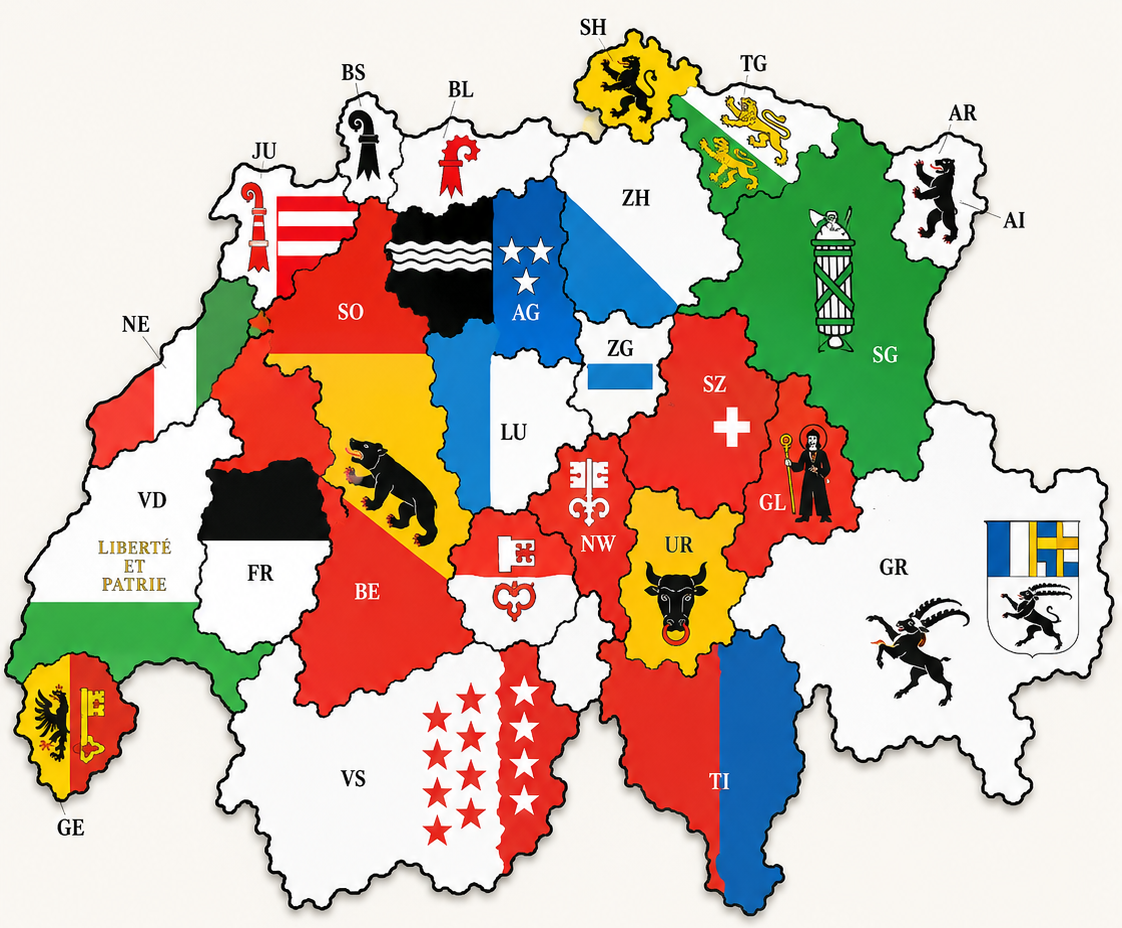
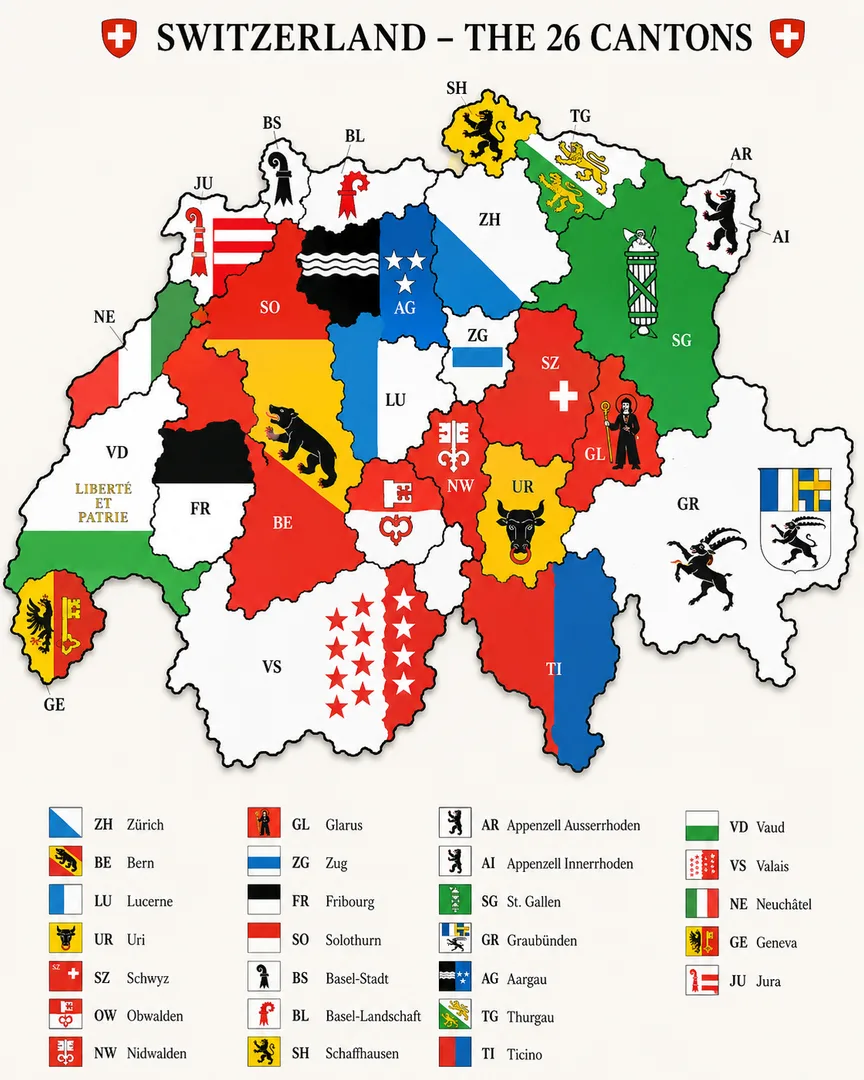
26 Cantons - 26 Fascinating Facts About Switzerland
Aargau — Habsburg Castle, the ancestral home of the Habsburg dynasty, is located in this canton. The dynasty later ruled vast territories across Europe.
Appenzell Ausserrhoden — In some local villages, New Year is celebrated twice: on 31 December according to the Gregorian calendar and on 13 January according to the Julian calendar.
Appenzell Innerrhoden — Every year on the last Sunday in April, residents gather in the open air for the Landsgemeinde, a traditional assembly where they vote directly on important cantonal matters.
Basel-Landschaft — This canton is home to Augusta Raurica, Switzerland’s largest archaeological park and the site of one of the best-preserved Roman theatres north of the Alps.
Basel-Stadt — The entire canton consists of just three municipalities: the city of Basel and the smaller communities of Riehen and Bettingen.
Bern — Bern’s beautifully preserved Old Town is a UNESCO World Heritage Site.
Fribourg — Fribourg is an officially bilingual canton where both French and German are widely spoken.
Geneva — The Palace of Nations in Geneva serves as the United Nations’ European headquarters and is the organisation’s second-largest centre after New York.
Glarus — With a population of just over 6,000, the town of Glarus is considered Switzerland’s smallest cantonal capital.
Graubünden — Graubünden is Switzerland’s only trilingual canton. German, Italian and Romansh are all traditionally spoken here.
Jura — Jura is Switzerland’s youngest canton. It was officially established in 1979 after separating from the canton of Bern.
Lucerne — The famous Chapel Bridge is considered the oldest covered wooden bridge in Europe. A series of historic paintings can still be seen beneath its roof.
Neuchâtel — The towns of La Chaux-de-Fonds and Le Locle were designed around the needs of the watchmaking industry. Their unique urban layout is recognised as a UNESCO World Heritage Site.
Nidwalden — The CabriO cable car carries visitors to the top of Mount Stanserhorn. It was the world’s first double-decker cable car with an open-air upper deck.
Obwalden — The geographical centre of Switzerland is located on the Älggi-Alp, a remote alpine plateau in this canton.
Schaffhausen — The canton is home to the Rhine Falls, widely regarded as Europe’s largest waterfall by water volume.
Schwyz — The canton of Schwyz gave Switzerland its name. The red background of its flag also influenced the design of the Swiss national flag.
Solothurn — The city of Solothurn has a remarkable connection with the number 11. It is known for its 11 churches and chapels, 11 fountains and 11 towers, as well as a special clock with only 11 hour markings.
St. Gallen — The Abbey Library of St. Gallen is considered the oldest library in Switzerland. Its collection dates back to the eighth century.
Thurgau — Often nicknamed the “apple canton”, Thurgau is known for its rolling countryside and extensive fruit orchards.
Ticino — Despite its relatively small size, Ticino offers an extraordinary variety of landscapes, ranging from glaciers and alpine valleys to gentle hills and palm trees.
Uri — Uri is home to the Rütli Meadow, often described as the “cradle of Switzerland”. According to legend, representatives of the original cantons took their historic oath of alliance there.
Valais — The Great Aletsch Glacier, located in Valais, is around 20 kilometres long and is the largest glacier in the Alps.
Vaud — The terraced vineyards of Lavaux cover approximately 800 hectares. They form Switzerland’s largest continuous wine-growing region and are protected as a UNESCO World Heritage Site.
Zug — Zug is sometimes called the “land of cherries”. Its cherry-growing tradition dates back more than 600 years, and the fruit is used to make kirsch and the famous Zug cherry cake.
Zurich — The city of Zurich, the cantonal capital, is the largest city in Switzerland.
Also available in
Tags

Jojo is Joyful Journeys!