Morges: The Lake Geneva Town Where Nobody Hurries
When the day calls for calm, an easy walk, a good apéro and a beautiful view, Morges is somehow always the place that comes to mind. This small town in the canton of Vaud never fails to charm: Lake Geneva, old streets, views across the water to France and Mont Blanc, and flowers everywhere — the streets and the waterfront seem to be permanently in bloom.
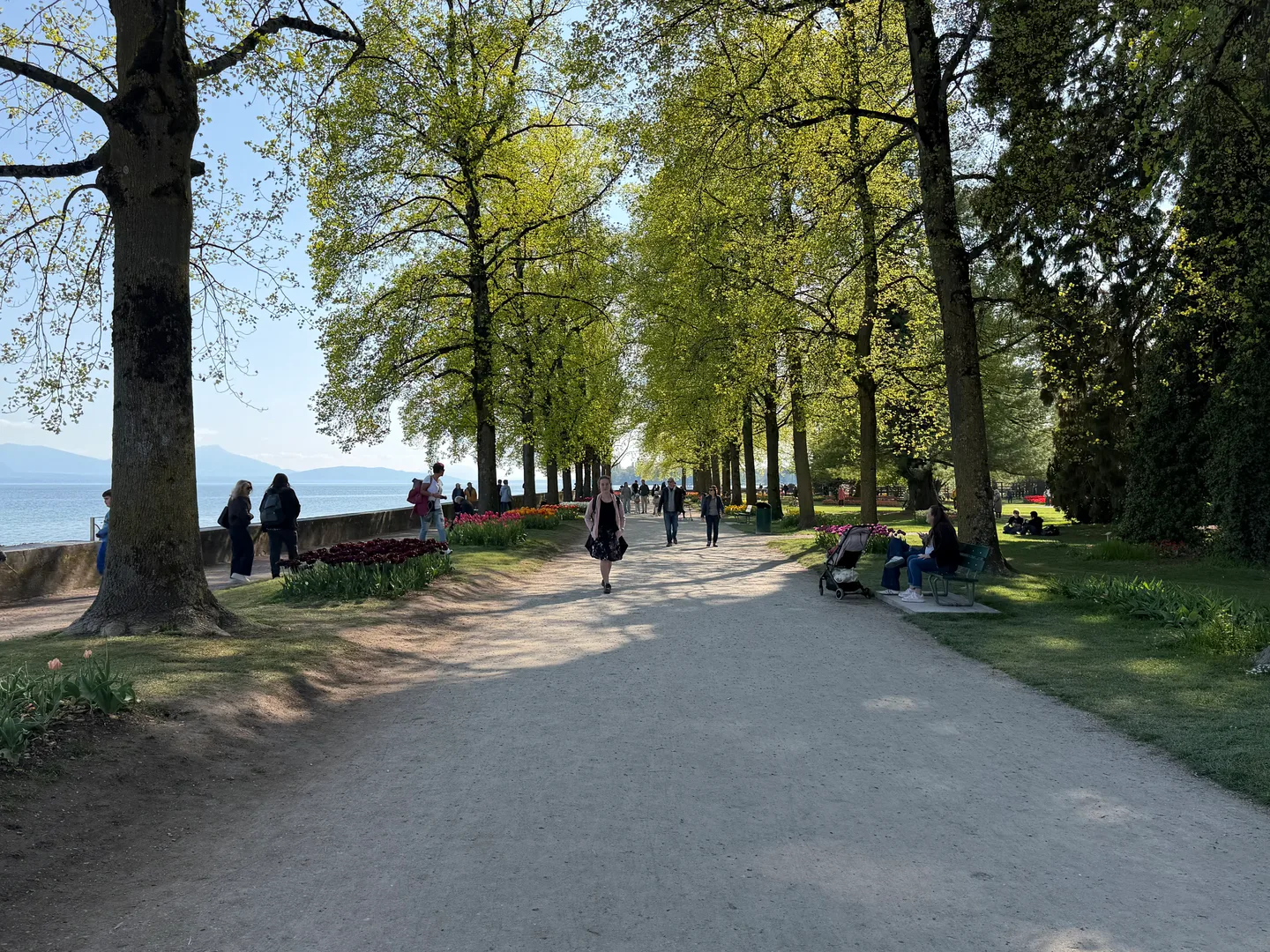
That impression is no accident. Flowers are the town's official calling card; Morges is known as la fleur du Léman, the flower of Lake Geneva. Since 1971 the Parc de l'Indépendance has hosted the Fête de la Tulipe every spring: roughly 140,000 tulips of nearly 350 varieties spread across 30,000 square metres, free to visit. The festival usually runs from late March to early May, though the exact dates shift each year with the weather. In summer and autumn, dahlias take over.
The walkable part of town is genuinely small, and that is precisely its charm. There's no urge here to rush or to work through a checklist. It's far more pleasant simply to wander the old town, stop by the castle, come out to the lake, stroll along the flowering promenade and look across at the Alps on the far shore.
Morges isn't a town for a packed itinerary. It's a town for a few quiet hours, after which both the heart and the head feel lighter.
A walking route through Morges
Allow two to three hours for a relaxed walk — more if you plan to sit a while, take in the views, have a bite on the Grand-Rue and try some local wine.
Arriving by train, it's about a ten-minute stroll downhill from the station to the castle. By car, there's a large car park right by the castle.
The castle and its museums
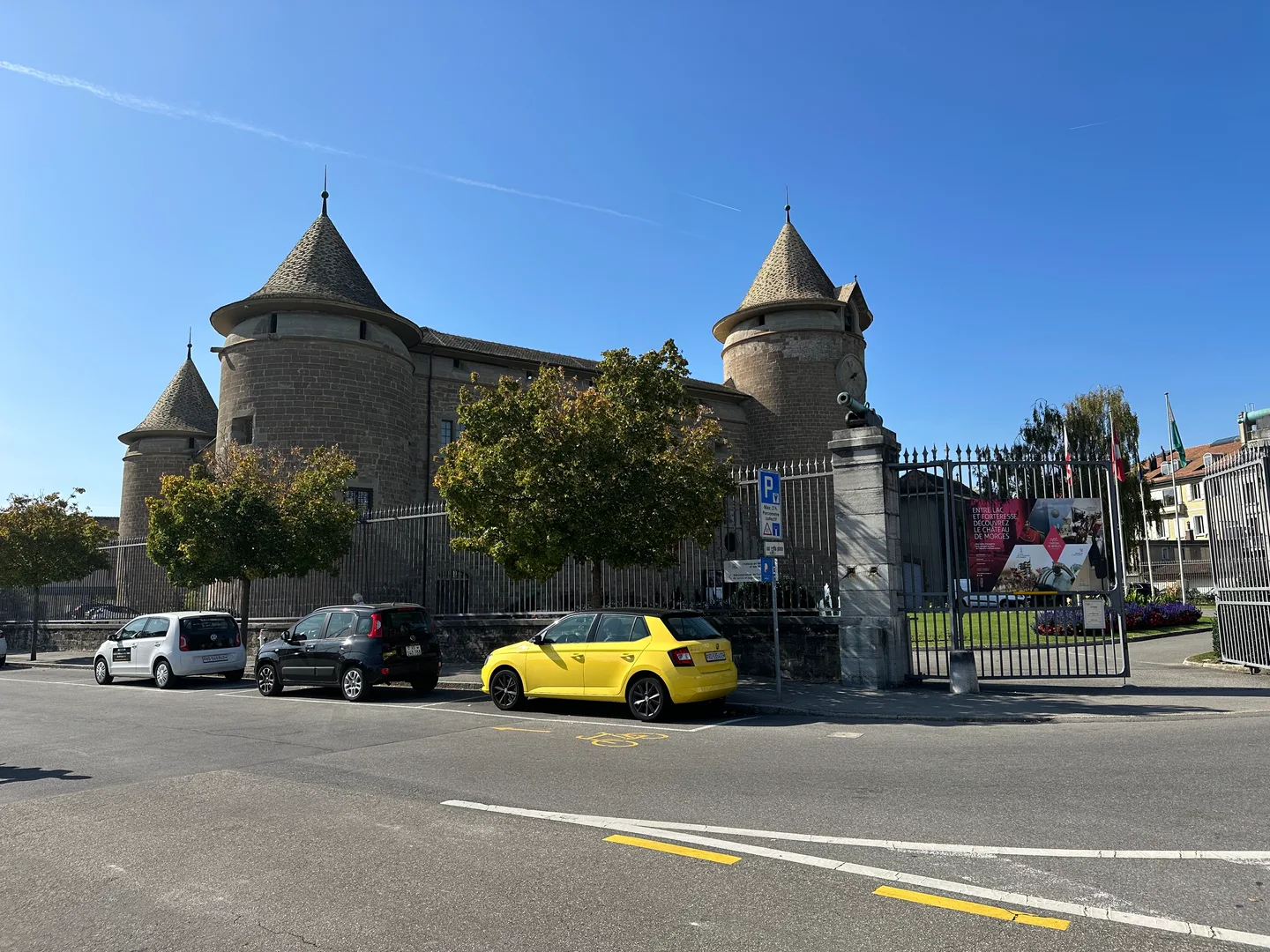
Château de Morges is a late thirteenth-century fortress standing directly on the shore. Construction began around 1286, together with the town itself, and it follows the classic carré savoyard plan: a regular square with round towers at each corner.
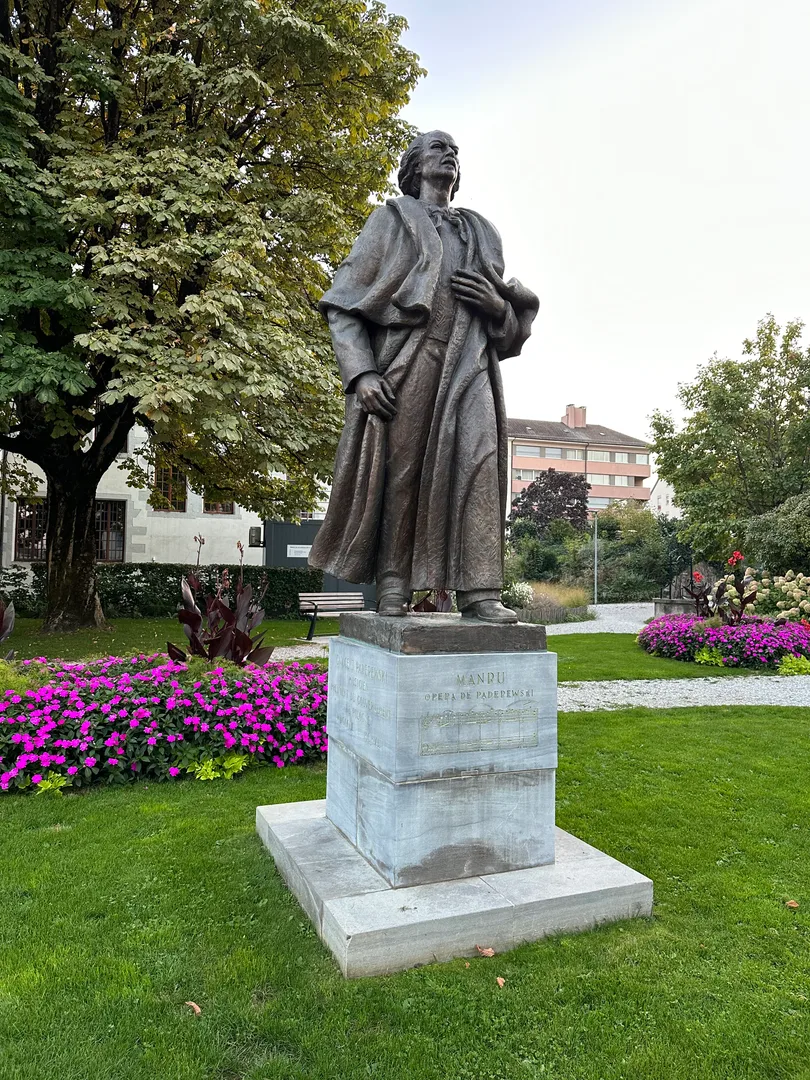
Five museums share the building — Vaud military history, artillery, the cantonal gendarmerie, historical figurines and the Paderewski Museum. The figurine collection, assembled by Raoul Gérard, is the largest in Switzerland: some 40,000 tin figures, of which around 5,000 are displayed as reconstructions of famous battles. The Paderewski Museum is devoted to Ignacy Jan Paderewski, the Polish pianist and statesman who lived just outside Morges from 1897 to 1940.
The castle and its courtyard are rewarding even without a long tour of the exhibitions. Worth noting: the museums are closed on Mondays and Tuesdays, and entry is free on the first Sunday of the month.
Parc de l'Indépendance
Immediately behind the castle lies the Parc de l'Indépendance, a lovely park right on the lake — a good place to sit for a while, or to start the walk along the promenade.
It has a history of its own. The land was once common grazing ground; in 1845 some sixteen thousand square metres were reclaimed from the lake, an English-style garden was laid out in 1884, and the park took its present name in 1898, for the centenary of Vaud's independence. Today it holds around fifty species of trees from every continent, the oldest chestnuts dating to the mid-eighteenth century. This is the park that turns into a field of tulips each spring.
The promenade and the harbour
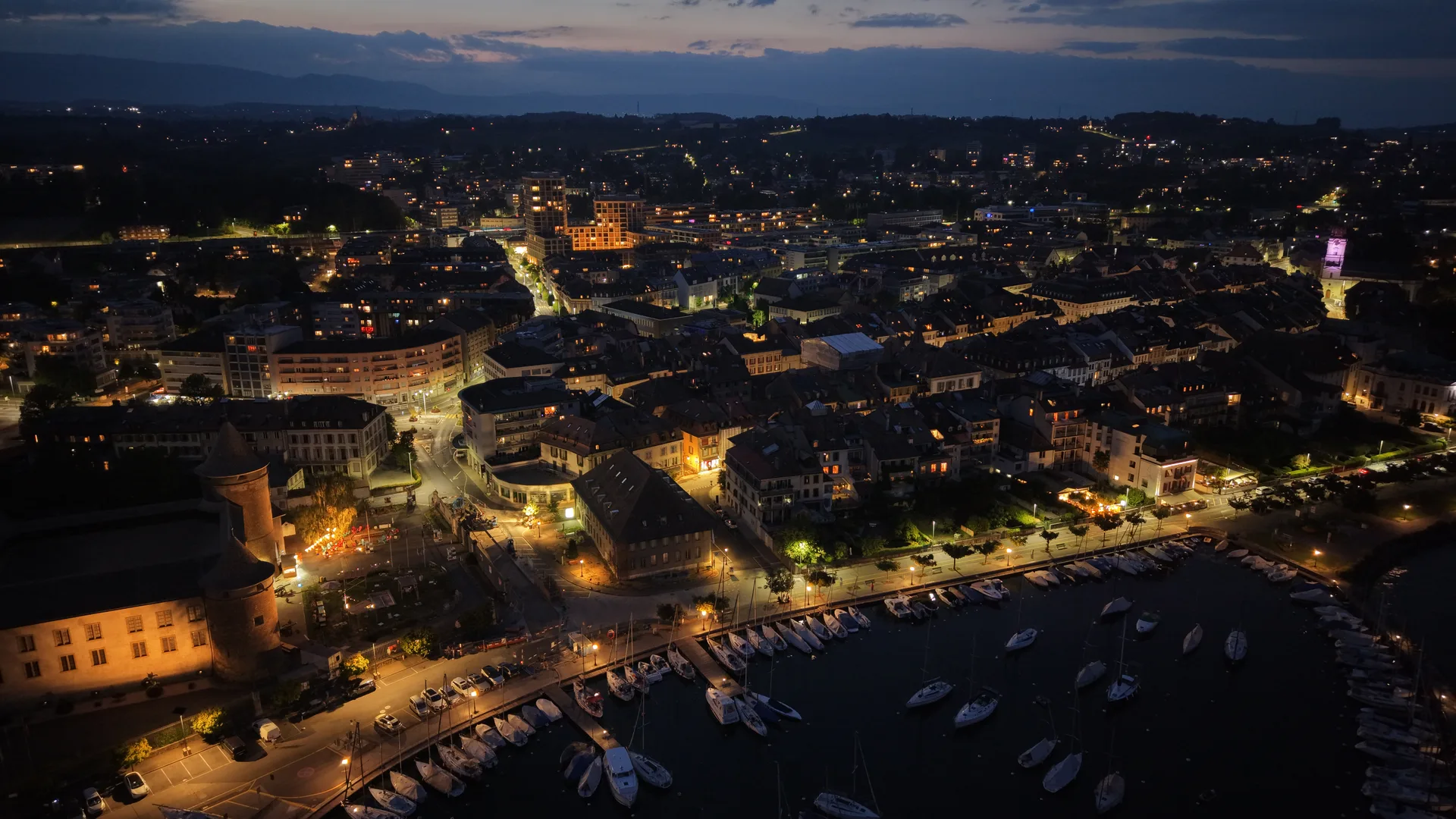
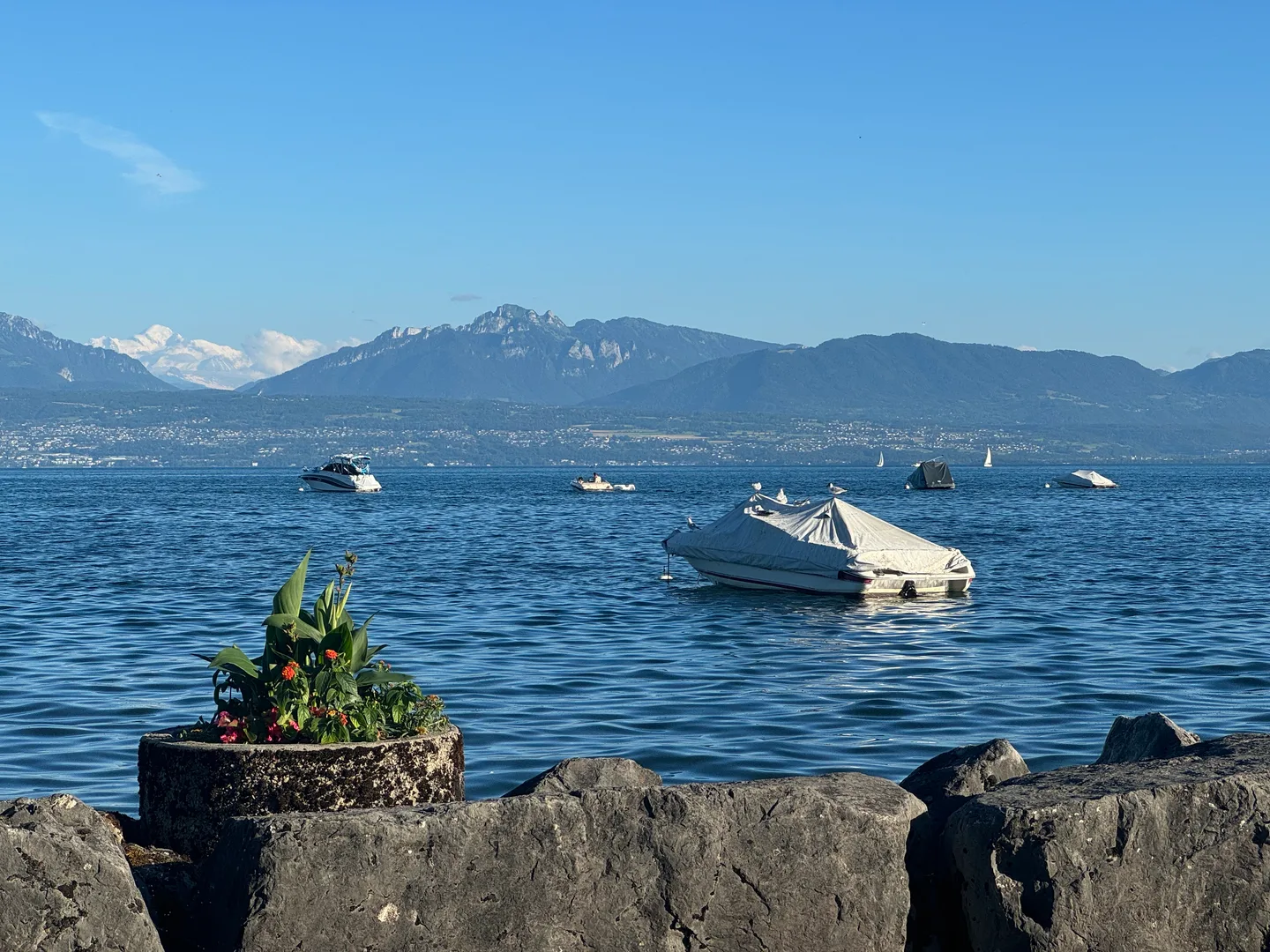
Quai Igor-Stravinski is probably the most pleasant spot in town: yachts, open water, and on a clear day a view of Mont Blanc. It's worth walking the whole stretch, from the castle to the harbour.
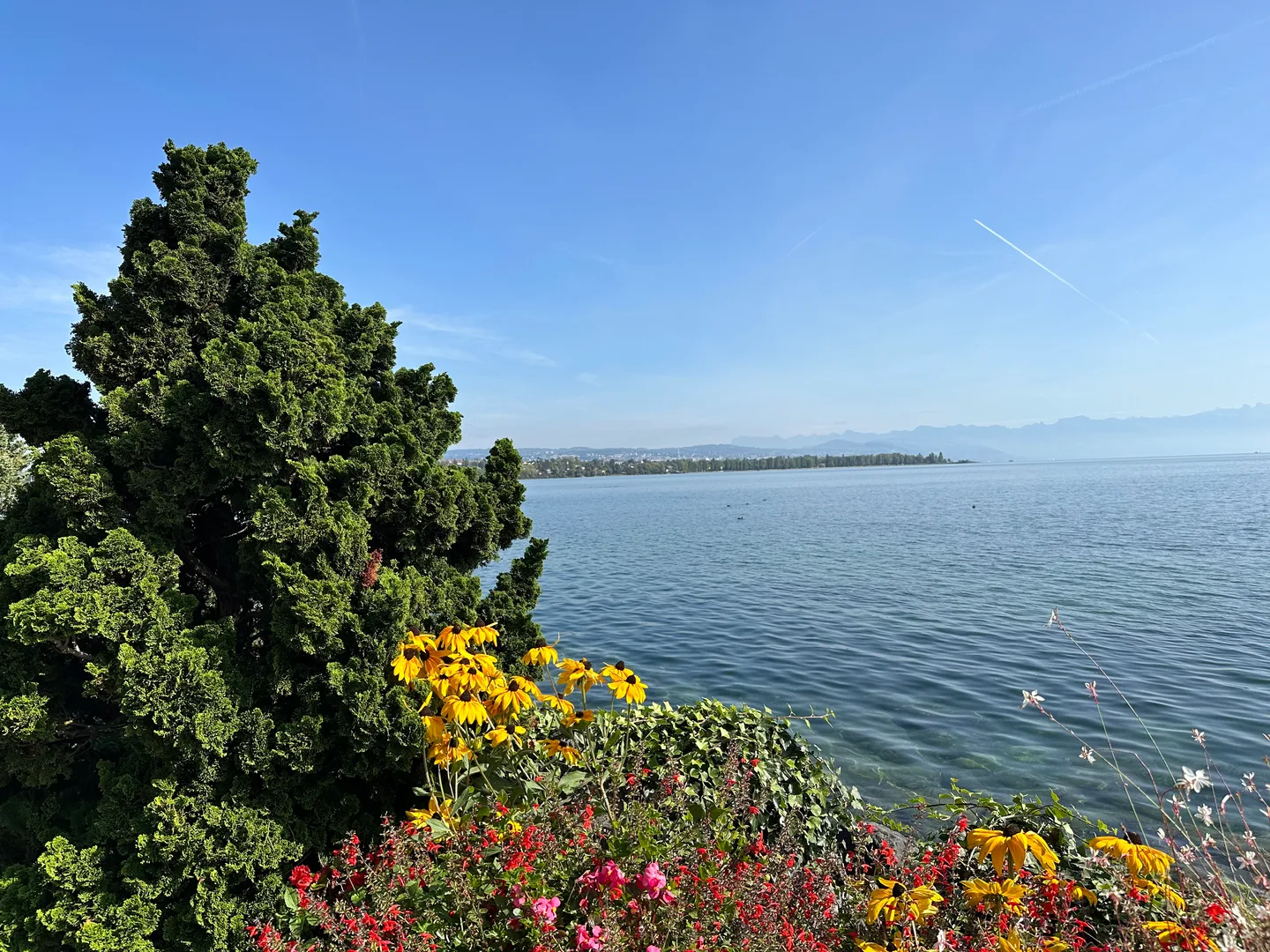
The harbour didn't simply appear, incidentally. The Bernese built it around 1690 as a naval port, in case Savoy needed answering. The war fleet on Lake Geneva proved short-lived, the harbour turned commercial, and today it shelters pleasure boats and yachts.
From the same landing stage, CGN boats run from spring to autumn — including a service across to Yvoire in France.
The Protestant church
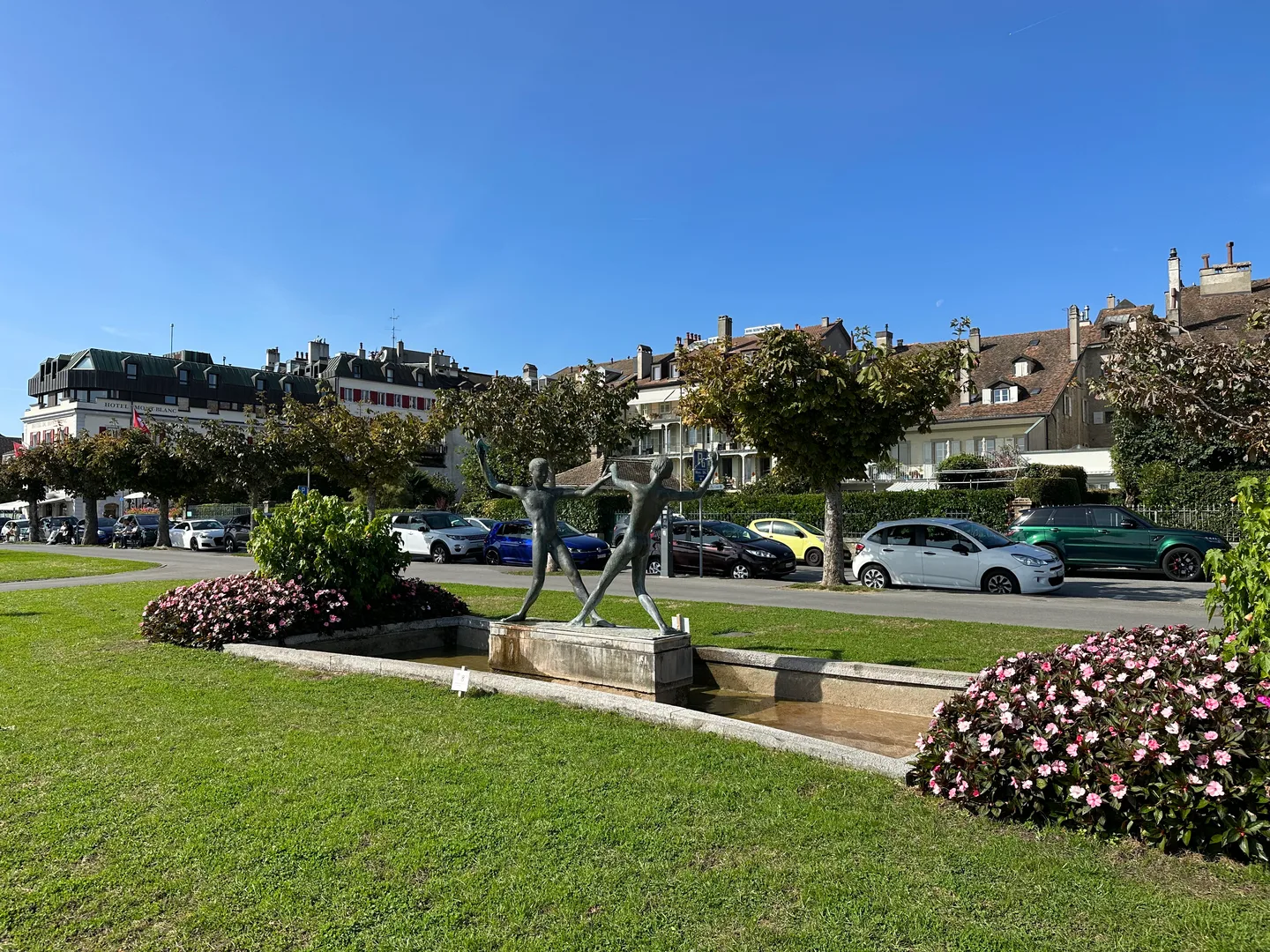
The Protestant church of Morges — the Temple de Morges, since in French a Reformed church is a temple rather than an église — is the one whose tall tower is visible from both the promenade and the harbour.
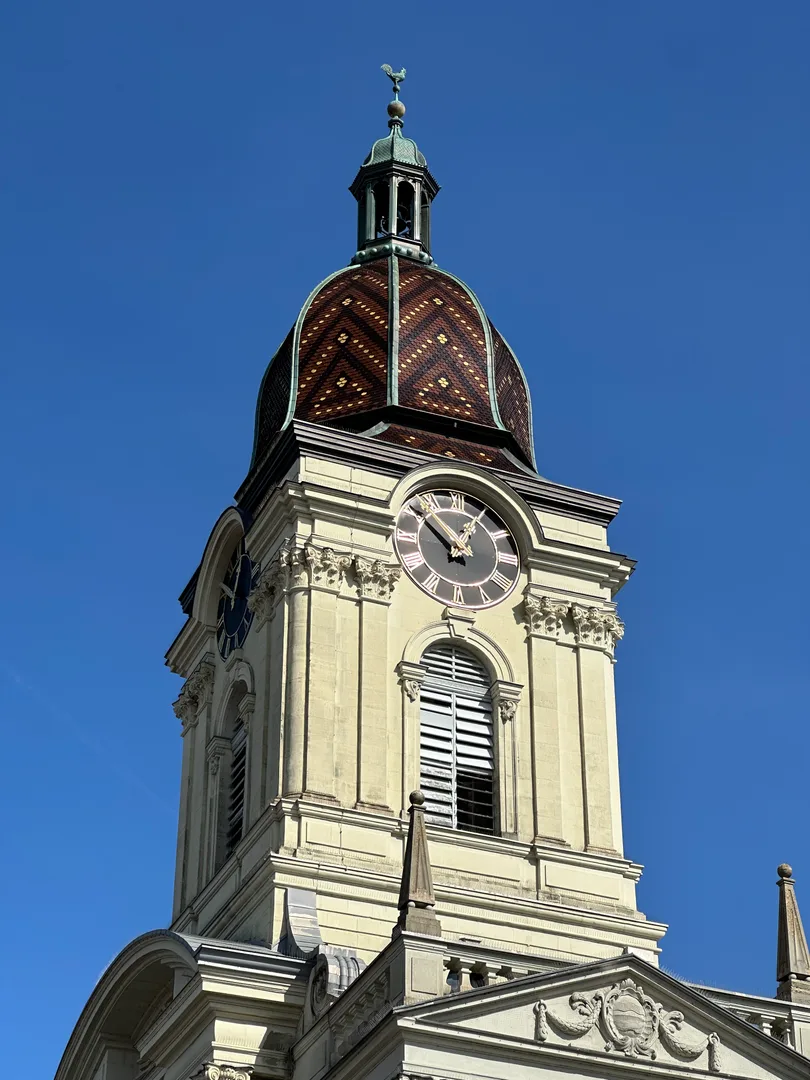
A church has stood on this site since 1306, originally as a Catholic chapel. It became Protestant after the Reformation. The old building eventually fell into disrepair, and in 1769 work began on a new one to designs by the Bernese architect Erasmus Ritter. In 1771, with construction nearly complete, the bell tower subsided and was badly damaged; the entire west façade had to be taken down and rebuilt to plans by the Lyon architect Léonard Roux. The church was finally consecrated in 1776. It is now considered one of the finest examples of late baroque in French-speaking Switzerland and is listed as a cultural monument of national importance.
If the door is open, it's well worth stepping inside. The interior isn't opulent in the Catholic sense but restrained and characteristically Reformed — which is exactly what makes it interesting. A single rectangular nave is ringed by galleries, a shallow transept gives the building the shape of a Greek cross, and it ends in a rounded apse holding the pulpit, an unusual arrangement in Protestant architecture.
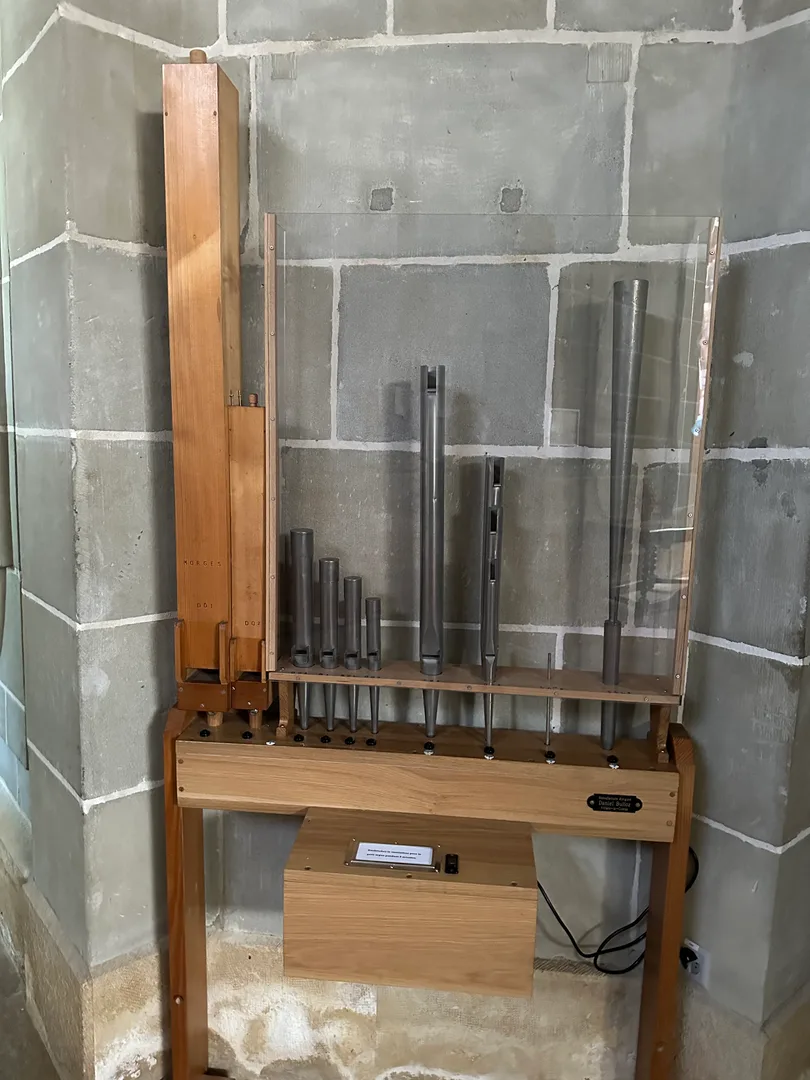
In 2022 a new organ arrived from the workshop of Jürgen Ahrend in Leer, Germany: 40 stops, three manuals and pedal, installed inside the existing 1896 case. It was inaugurated alongside the church's 250th anniversary, and Morges has been known for its organ and classical concerts ever since. A few organ pipes stand near the entrance, and visitors are allowed to play them and hear how they sound.
The old town and the Grand-Rue
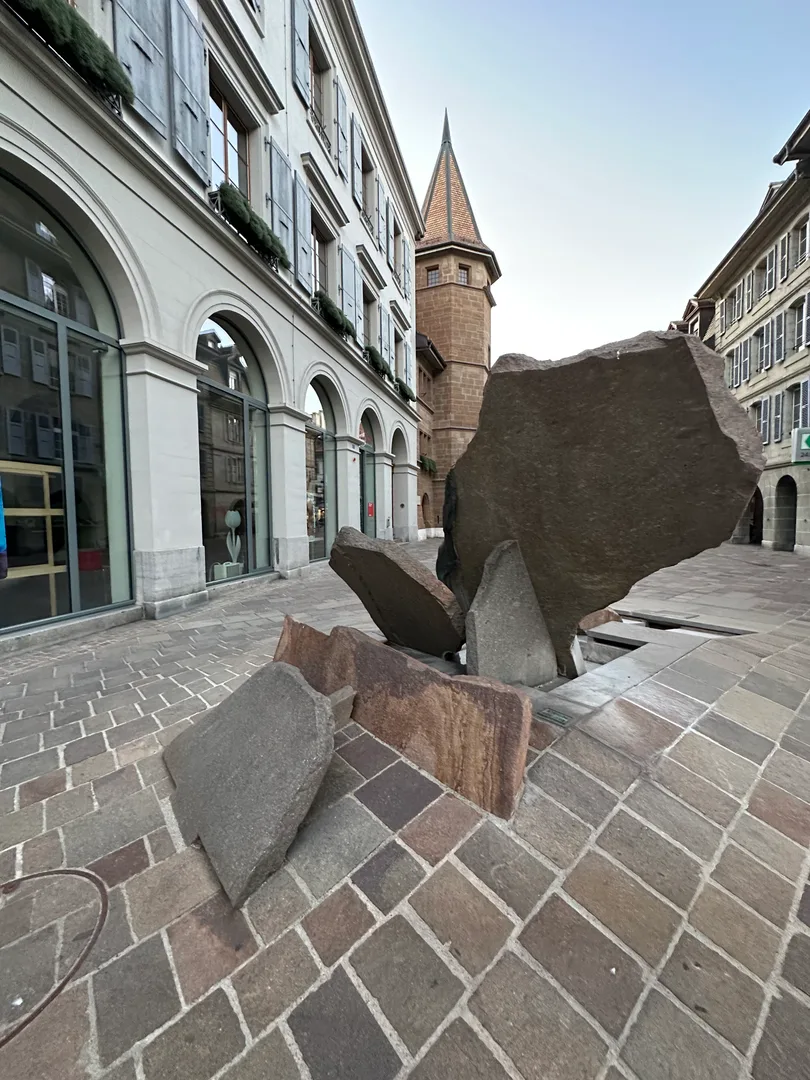
From the church it's an easy climb into the old town and onto the Grand-Rue, a pedestrian street of old houses, cafés and small shops. The buildings have barely changed since they were rebuilt in stone during the Renaissance and the eighteenth century: pressed tight against one another, running deep back from the street, their rooflines all at different heights.
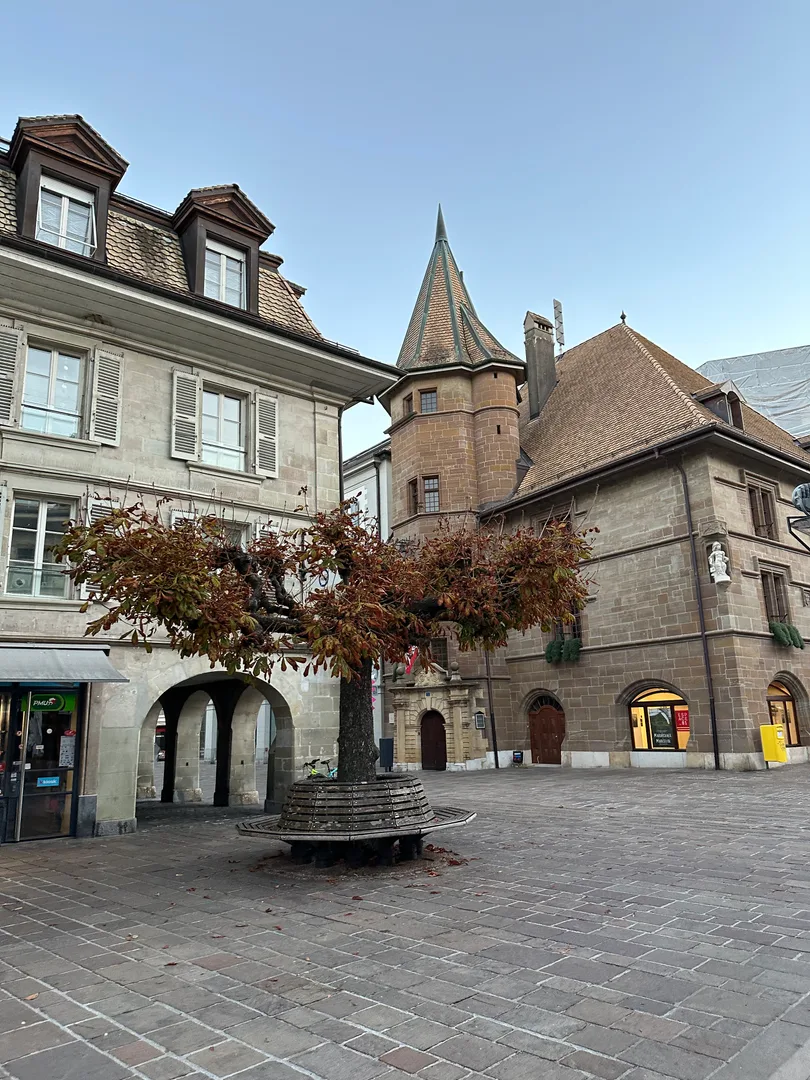
Look out for the town hall with its hexagonal tower, which hides a spiral staircase inside; the tourist office is in the same building. And in one of the sixteenth-century mansions on the Grand-Rue is the Musée Alexis Forel, named for the engraver and collector who gave the town his collection of furniture, ceramics and tapestries (check the opening hours in advance — they're seasonal).
For lunch and local specialities, Brasserie de l'Union at Grand-Rue 7 is a classic Swiss brasserie a couple of minutes from the lake. The menu tends to feature filets de perche, fondue, malakoffs, papet vaudois, meat cooked on a hot stone, and game in autumn.
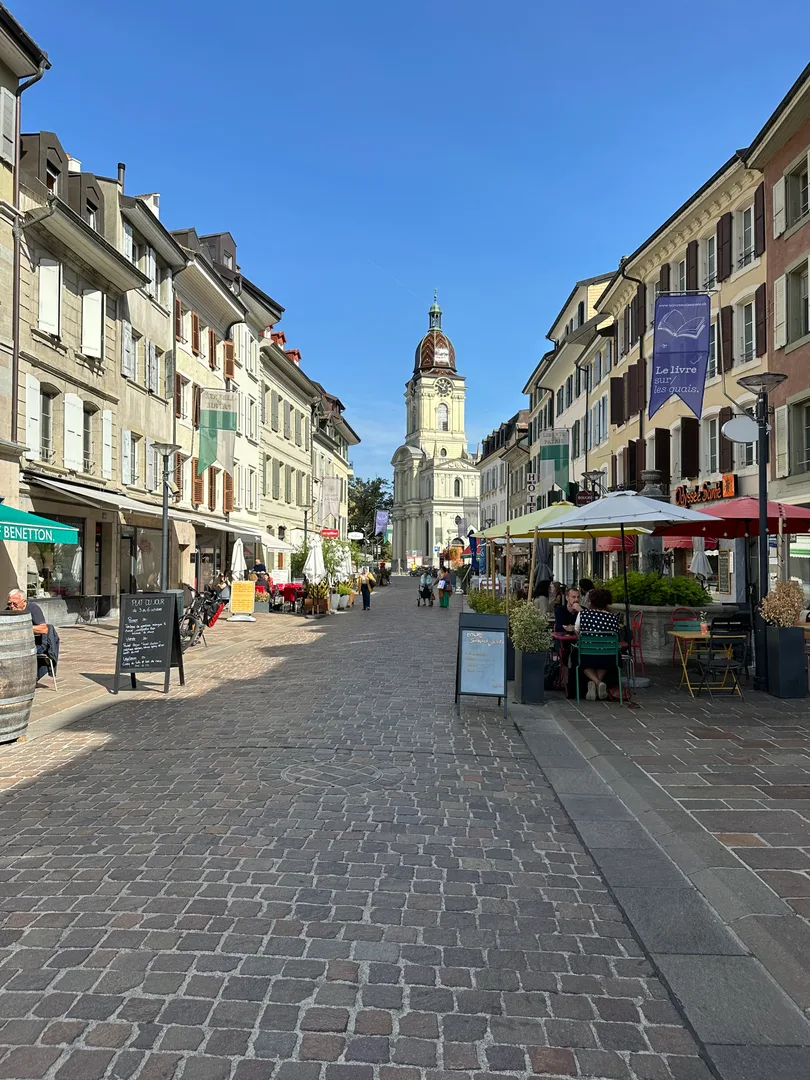

This route is enough to see the best of Morges: to rest, enjoy the views, eat well and come away with your batteries recharged.
With a full day, add the vineyards of La Côte and Vufflens-le-Château, a strikingly photogenic brick castle among the vines. It's privately owned and closed to visitors, so the point is the walk and the view. Another option is a boat trip on Lake Geneva.
A little history
Morges grew up on the shore of Lake Geneva in the thirteenth century. It was founded by Louis of Savoy around 1286 as a fortified trading post and as a means of pressuring the Bishop of Lausanne, Savoy's chief rival on the northern shore. The castle went up at the same time and remains one of the town's defining landmarks. Morges received its municipal charter in the 1290s, and through the Middle Ages the Savoyard court stayed here from time to time; in 1416 the castle received Emperor Sigismund.
Its sheltered bay quickly made Morges an important trading point, handling wine, grain and other goods from the La Côte region. In 1536 the town, along with the whole Pays de Vaud, passed to Bern, and for the next two and a half centuries the castle served as the seat of the Bernese bailiff. After the revolutionary events of 1798, Morges became part of the new canton of Vaud.
The town gradually shifted from a military and trading centre to a quiet resort, popular with writers, musicians and travellers.
The water off Morges holds something far older, too: the shallows preserve the remains of prehistoric pile dwellings, studied since the mid-nineteenth century and now part of the UNESCO World Heritage site "Prehistoric Pile Dwellings around the Alps."
Who lived here
Igor Stravinsky lived in Morges from 1915 to 1920. It was here, with the local writer Charles Ferdinand Ramuz, that he conceived The Soldier's Tale. The promenade carries his name.
Ignacy Jan Paderewski, the world-famous pianist and independent Poland's first prime minister, settled just outside Morges in 1897 and stayed for the rest of his life. His museum is now in the castle.
Audrey Hepburn lived in neighbouring Tolochenaz, five minutes from Morges, from 1963 until her death. She shopped at the Morges market, and in 1969 she married Andrea Dotti at the town hall here. She is buried in the village cemetery in Tolochenaz.
All of which makes modern Morges a curious blend: a medieval town, an old harbour, a wine region and an elegant lakeside resort.
Where the name comes from
The name Morges comes not from a person but from the river La Morges, at whose mouth the town was founded in the thirteenth century. Early documents give it as Morgia, the form in which the town itself first appears in the late 1200s. Both waterways even show up on the town's coat of arms: the red and white come from Savoy, while two wavy bands stand for the Morges and the Bief stream.
The origin of the word itself is still debated. The traditional reading links Morgia / morga to a Celtic root meaning "border, boundary" — a common name for rivers that served as natural frontiers, and related forms such as Morge, Murg and Morgex turn up right across the Alpine arc. A more recent toponymic argument traces it instead to an Indo-European base meaning roughly "marsh, marshy river."
So the story of the name runs something like this: first came the river Morgia → then a town grew up beside it → the town took the river's name → and over time Morgia became Morges.

Events
Locality: Morges
Region: Vaud
- Caves Ouvertes Vaudoises — The Swiss Wine Weekend That Lets You Into Local LifeMay
- The Day Rolle Winds Back a Century: The Barrel Organ Festival on Lake GenevaAugust
Country: Switzerland
- Medieval Spectacle Hinwil — Switzerland's Biggest Knight TournamentMay
- Swiss National Day — The Complete Guide to August 1st (2026 Edition)August 1
- Tractors, Confetti and New Wine: Harvest Festivals in SwitzerlandSeptember - October
- When the Bells Come Down the Mountain: Switzerland’s Living Alpabzug TraditionSeptember - October
- The light show “Rendez-vous Bundesplatz” in Bern: it’s worth seeingOctober
Also available in
Tags

Jojo is Joyful Journeys!