Interesting Facts About Switzerland — How Well Do You Know This Country?
Switzerland is one of the most fascinating countries in Europe — and one of the most misunderstood. Most people know the chocolate, the watches, and the mountains. But beyond the postcard, there's a country full of surprising rules, unusual traditions, and facts that make you stop and think.
Here’s a collection — organized by theme — of the things that make Switzerland unlike anywhere else. At the bottom, you’ll find several themed quizzes to test how much you actually know.
Politics and Government
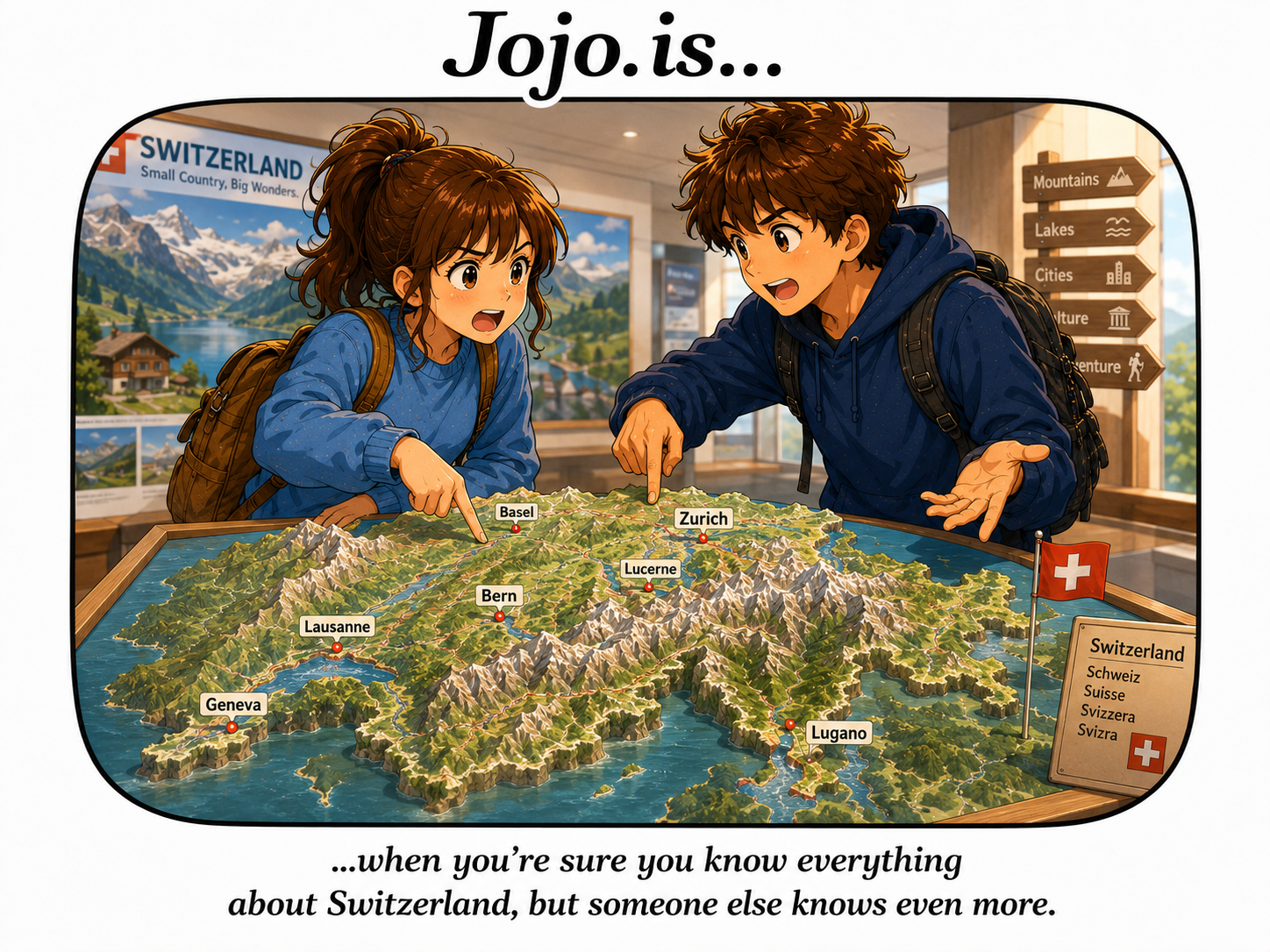
26 cantons, 4 languages, 0 capital. Switzerland has 26 cantons, four official languages (German, French, Italian, and Romansh), and — technically — no capital city. Bern is the Bundesstadt (federal city), the seat of government, but it has never been officially declared the capital.
Romansh is spoken by fewer than 1% of the population. It's one of four national languages, protected by the constitution, but spoken by roughly 40,000 people — mainly in the canton of Graubünden.
The government has 7 members — and they share power equally. The Federal Council (Bundesrat) consists of seven members who collectively lead the country. There is no prime minister. The presidency rotates annually among the seven — it's mostly a ceremonial role. The president doesn't have more power than the other six.
Direct democracy is real, not symbolic. Swiss citizens vote on national referendums multiple times a year. Any citizen can launch a popular initiative to change the constitution if they collect 100,000 signatures. This isn't decorative — it shapes actual policy.
Switzerland is not in the EU. Despite being surrounded by EU countries, Switzerland has repeatedly voted against joining. It maintains its relationship with the EU through a complex web of bilateral agreements.
Switzerland joined the UN only in 2002. One of the last countries in the world to join — after a national referendum in which 54.6% voted yes. The headquarters of many UN agencies are in Geneva, but Switzerland itself stayed outside the organization until the 21st century.
History and Symbols
Neutrality since 1815. Switzerland's armed neutrality was formally recognized at the Congress of Vienna in 1815. The country has not fought in an international war since. This neutrality is not passive — Switzerland maintains a military and mandatory service for male citizens.
The Red Cross was born in Geneva. Henry Dunant, a Swiss businessman, witnessed the aftermath of the Battle of Solferino in 1859 and was horrified by the lack of medical care for wounded soldiers. His efforts led to the founding of the International Committee of the Red Cross (ICRC) in 1863. The Red Cross symbol — a red cross on white — is the Swiss flag with inverted colors, a tribute to its Swiss origin.
The Swiss flag is square. Only two sovereign states have square flags: Switzerland and Vatican City. Every other national flag in the world is rectangular.
The Swiss Army knife was first made in 1891. Karl Elsener created a compact folding knife for Swiss soldiers. His company later became Victorinox — named after his mother, Victoria. Today, over 45,000 Swiss Army knives are produced daily.
Food and Drink
Switzerland consumes more chocolate per capita than any other country. Roughly 10 kg per person per year. Swiss chocolate became world-famous thanks to pioneers like Daniel Peter (who invented milk chocolate in 1875) and Rodolphe Lindt (who developed the conching process that makes chocolate smooth).
Over 450 varieties of cheese are produced in Switzerland. From Gruyère to Emmental, from Appenzeller to Tête de Moine. Cheese-making is not just an industry — it's a living Alpine tradition stretching back centuries.
Fondue is the unofficial national dish. Melted cheese, white wine, a pot, long forks, and bread. Simple in concept, deeply ritualistic in practice. There are strict local opinions about which cheese blend is correct — and they vary by region.
Engineering, Science, and Innovation
Swiss watches account for over half of the world's luxury watch market. Brands like Rolex, Patek Philippe, Omega, and TAG Heuer are all Swiss. The Swiss watch industry nearly collapsed in the 1970s during the "quartz crisis" — then reinvented itself as a luxury craft rather than a timekeeping tool.
Swiss trains run on time — 92.5% of the time. SBB (Swiss Federal Railways) measures punctuality to the minute. The system is designed so precisely that connections between trains, buses, and boats align across the entire country.
The Gotthard Base Tunnel is the longest railway tunnel in the world. 57.1 km, running underneath the Swiss Alps. It opened in 2016 after 17 years of construction and fundamentally changed rail travel between northern and southern Europe.
The World Wide Web was invented at CERN, near Geneva. In 1989, British scientist Tim Berners-Lee, working at the European Organization for Nuclear Research (CERN), created the World Wide Web. CERN made the technology freely available — and changed the world.
LSD was discovered in Switzerland. In 1943, chemist Albert Hofmann, working at Sandoz Laboratories in Basel, accidentally discovered the psychoactive effects of LSD-25. His famous bicycle ride home — the world's first acid trip — happened on April 19, 1943, now known as "Bicycle Day."
Velcro was invented by a Swiss engineer. In 1941, George de Mestral returned from a walk in the Jura mountains and noticed burrs stuck to his dog's fur. He studied them under a microscope and invented the hook-and-loop fastener — Velcro. The name combines the French words velours (velvet) and crochet (hook).
Albert Einstein developed the theory of relativity in Bern. While working as a patent clerk at the Swiss Federal Institute of Intellectual Property, Einstein wrote four groundbreaking papers in 1905 — including the special theory of relativity and E=mc².
Nature and Geography
48 peaks above 4,000 meters. Switzerland packs an extraordinary density of high mountains into a small country. The Matterhorn (4,478 m) is the most iconic, but Monte Rosa's Dufourspitze (4,634 m) is actually the highest point in Switzerland.
Jungfraujoch — the highest railway station in Europe. At 3,454 m above sea level. The Jungfrau Railway, opened in 1912, climbs through the Eiger and the Mönch mountains via tunnels carved inside the rock.
The Rhine Falls is the largest waterfall in Europe by volume. Located near Schaffhausen, it's 150 meters wide and 23 meters high. Not the tallest — but the sheer volume of water crashing down is extraordinary.
Lake Geneva is the largest lake in Western Europe. Shared between Switzerland and France, it covers 580 km². The Jet d'Eau fountain in Geneva shoots water 140 meters into the air from its surface.
65,000 km of marked hiking trails. That's more than one and a half times around the Earth. Switzerland's trail network is maintained by volunteers and marked with a standardized system of yellow signs that tell you exactly how long each route takes.
Unusual Laws and Customs
It's illegal to own just one guinea pig. Guinea pigs are social animals, and Swiss animal welfare law requires that they be kept in pairs. If one dies, there are even rental services so the surviving guinea pig isn't left alone while you decide whether to get a new one.
Noise rules after 10 PM are taken seriously. In many Swiss communes, building regulations and house rules restrict noise after 10:00 PM — including flushing toilets, taking baths, and doing laundry in apartment buildings. This isn't a federal law, but a widespread practice enforced through rental contracts and building rules. Neighbors will notice.
Switzerland has enough nuclear bunkers to shelter 114% of its population. The country requires shelters in all new residential buildings. No other country comes close to this level of civil defense infrastructure.
Women received the right to vote at the federal level only in 1971. One of the last countries in Europe to grant women's suffrage. In the half-canton of Appenzell Innerrhoden, women couldn't vote on cantonal matters until 1991 — when the Swiss Federal Court forced the change.
Mandatory military service — or alternatives. Swiss men are required to serve in the military (currently about 18 weeks of basic training plus annual refresher courses until age 30–34). Those who choose not to serve must complete civilian service, which is 1.5 times longer. After service, soldiers keep their personal weapon at home — which is why Swiss gun ownership is high despite strict regulation.
Brands and Icons
Toblerone's shape is inspired by the Matterhorn. The triangular chocolate bar, created in Bern in 1908, echoes the profile of Switzerland's most famous mountain. Look closely at the Matterhorn logo — there's a hidden bear inside the mountain silhouette (the symbol of Bern).
The World Economic Forum meets in Davos every January. A small ski town in the Graubünden Alps becomes the center of global business and politics for one week each year.
Nestlé, the world's largest food company, is Swiss. Headquartered in Vevey, on Lake Geneva. Also Swiss: Novartis and Roche (pharma), ABB (engineering), Swatch Group and Richemont (luxury), and Zurich Insurance.
Chevrolet was founded by a Swiss emigrant. Louis Chevrolet was born on December 25, 1878, in La Chaux-de-Fonds, Canton of Neuchâtel — the same town famous for Swiss watchmaking. He emigrated to the USA and co-founded the car brand in 1911. One popular theory claims the Chevrolet logo is a horizontally stretched Swiss cross — though other origin stories exist.
The typeface Helvetica is Swiss. Created in 1957 by Max Miedinger and Eduard Hoffmann in Münchenstein, near Basel. Named after Helvetia — the Latin name for Switzerland. It's one of the most widely used typefaces in the world — you've seen it in the New York subway, on BMW logos, and on tax forms.
The Name Itself
Switzerland's Latin name connects Julius Caesar to your car's license plate. The Celtic Helvetii tribe — which fought against Caesar's armies around 58 BC — gave its name to the entire Swiss territory. The Latin name Helvetia still appears on Swiss stamps and coins. The letters CH on Swiss cars and in the internet domain .ch stand for Confoederatio Helvetica — the Swiss Confederation in Latin. A single abbreviation that links a 2,000-year-old tribal name to a modern country code.
Things You Probably Didn't Expect
Switzerland has a merchant navy — despite having no sea. Among all landlocked countries in the world, Switzerland operates the largest merchant marine fleet. Ships are registered under the Swiss flag and operate through Basel's Rhine port and on international waters. A navy without a coastline — peak Switzerland.
Fondue wasn't always the national dish. It became a nationwide symbol only in the 1950s, when it was added to the Swiss army menu. Before that, it was a regional specialty. The Swiss Cheese Union launched an advertising campaign in 1954 with the slogan FIGUGEGL — an abbreviation of the Swiss German phrase "Fondue isch guet und git e gueti Luune" (roughly: "Fondue is good and puts you in a good mood"). Just as Russians once had to be convinced to eat potatoes, the Swiss had to be marketed into eating fondue. It worked.

Quiz Time
Think you know Switzerland?
Test yourself:
🧩 Quiz 1: Swiss Culture, Customs, Festivals and Folk Music
🧩 Quiz 2: Swiss Food, Drinks and Specialties
🧩 Quiz 3: Basic Facts About Switzerland
🧩 Quiz 4: Famous Swiss Women and Men
More quizzes coming soon — follow Jojo.is... to be the first to try them.
Also available in
Tags
Jojo is Joyful Journeys!